MV Taw Win Thiri at Sittwe: Why New Delhi Will Never Risk Enmity with Chin-Kuki Communities
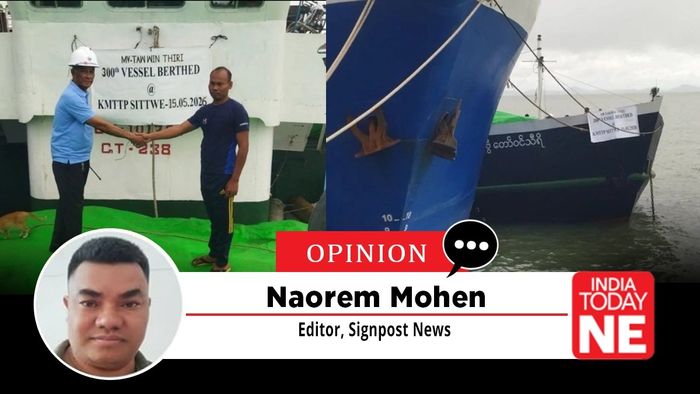
The KMMTTP Sittwe Port successfully berthed its 300th vessel since commissioning in May 2023 — the Indian cargo ship MV Taw Win Thiri, carrying 412.92 MT of general cargo. The vessel docked on 15 May 2026 at 0840 hrs, marking yet another important milestone in India’s assistance initiatives in Myanmar aimed at strengthening connectivity and ensuring reliable humanitarian and commercial supplies.
- May 18, 2026,
- Updated May 18, 2026, 4:55 PM IST
The KMMTTP Sittwe Port successfully berthed its 300th vessel since commissioning in May 2023 — the Indian cargo ship MV Taw Win Thiri, carrying 412.92 MT of general cargo. The vessel docked on 15 May 2026 at 0840 hrs, marking yet another important milestone in India’s assistance initiatives in Myanmar aimed at strengthening connectivity and ensuring reliable humanitarian and commercial supplies.
This is far more than a routine port operation. It is a powerful symbol of India’s deepening strategic footprint in the Bay of Bengal and a clear reminder of why New Delhi will never risk enmity with the Chin-Kuki communities that straddle the India-Myanmar border.
The Kaladan Multi-Modal Transit Transport Project (KMMTTP) runs straight through their ancestral homelands in Chin State and western Myanmar. Any misstep that alienates these groups would not only endanger one of India’s most vital strategic investments in the East but also threaten hard-won stability across Mizoram, Manipur, and the entire Northeast.
India has invested heavily in the Kaladan Project, with core components revised to an estimated cost of approximately Rs 2,904 crore (around $350–484 million). This covers the development of Sittwe Port, inland waterways along the Kaladan River, and critical road infrastructure.
Additional funding of over Rs 1,600 crore has been directed to the vital Paletwa–Zorinpui road segment, with further allocations supporting waterway enhancements and port operations. This financial commitment is powerfully backed by Union Minister Sarbananda Sonowal’s aggressive drive to develop inland waterways across the Northeast.
The government has rolled out a ₹5,000 crore long-term investment plan. Of this, ₹1,000 crore is already under active implementation, with another ₹1,000 crore targeted for completion by 2026. Major MoUs worth over ₹3,000 crore have been signed for new terminals, jetties, and improved navigability on the Brahmaputra and Barak rivers, covering Manipur, Assam, Mizoram, and other states.
In February 2026, Sonowal inaugurated key customs and tourist-cargo terminals in Dibrugarh on National Waterway-2. These projects are engineered to integrate seamlessly with the Kaladan corridor, which is expected to achieve full operations around 2027.
Such massive investment is not undertaken casually. It reflects New Delhi’s clear-eyed strategic understanding that the success of Kaladan hinges on stability and cooperation in the very regions where Chin communities wield considerable influence.
Creating enemies among them would directly put at risk this multi-hundred-crore project and India’s broader Act East Policy objectives.The Kaladan corridor is a game-changer for India’s Northeast. It provides a much-needed alternative to the perennially vulnerable Siliguri Corridor, often called the “Chicken’s Neck.”
By linking Kolkata by sea to Sittwe Port, then proceeding via inland waterways to Paletwa in Chin State and onward by road to Mizoram, the project can slash travel distances by around 700 km. This means faster, cheaper movement of goods, reduced logistical costs, boosted trade, and new economic opportunities for the landlocked states of Mizoram, Manipur, and Assam.
Geopolitically, Kaladan strengthens India’s maritime presence in the Bay of Bengal and serves as a practical counter to China’s expanding influence through the nearby Kyaukphyu port and the China-Myanmar Economic Corridor.
In today’s era of intense great-power competition, any disruption to Kaladan caused by ethnic conflict or instability would represent a self-inflicted strategic wound.
This is why New Delhi adopts a measured, pragmatic approach. The project passes through areas influenced by various Ethnic Armed Organisations (EAOs), many of which have links to Chin communities. Selective engagement for project security and smooth operations is essential. India simply cannot afford to turn these local stakeholders into adversaries.
The Chin people of Myanmar and the Kuki-Zo/Mizo communities in India’s Northeast are part of the same broader Zo ethnic family. They share language, culture, traditions, and a common history that colonial borders arbitrarily divided. These are not abstract or distant connections — they are living, breathing ties that influence daily life and politics on both sides of the border.
Mizoram’s relatively supportive stance toward Chin refugees fleeing Myanmar’s post-2021 instability is the most visible manifestation of this kinship. Local communities have extended solidarity based on shared identity, and this has been managed within the broader national framework.
This is the core reason New Delhi will never risk enmity with Chin-Kuki communities. Alienating this cross-border network carries unacceptable risks. It could seriously jeopardise security and progress along the Kaladan route. It might fuel cross-border militant linkages and intensify arms and narcotics flows from the Golden Triangle.
It could worsen existing tensions in Manipur, where Kuki-Zo communities already harbour deep concerns. It would squander the people-to-people goodwill that India has patiently cultivated as a strategic asset in the region.
Any Indian policy perceived as openly hostile toward Chin groups in Myanmar would immediately reverberate among their Kuki and Mizo brethren in Indian states. The backlash could complicate internal ethnic relations, strain border management, and create fresh tensions in already sensitive areas like Manipur.
In the complex frontier landscape of Northeast India, kinship is a double-edged sword. Managed wisely, it becomes a bridge for stability and cooperation. Handled poorly, it becomes a source of endless headaches.
The ethnic violence that erupted in Manipur in 2023 between Meitei and Kuki communities has brought immense suffering to all sides, with lives lost, villages destroyed, and deep scars left on the social fabric. However, the porous Indo-Myanmar border and shared ethnic ties have undeniably added an external layer of complexity, including refugee movements and occasional security incidents.
Even in handling this sensitive domestic crisis, the Centre has walked a tightrope of firmness and pragmatism. President’s Rule was imposed in early 2025 when required, massive central security forces were deployed, dialogues were initiated with stakeholders from all communities, and an elected government was eventually restored.
Throughout, New Delhi has firmly upheld Manipur’s territorial integrity and rejected any demands for ethnic division or separate administrative arrangements. This balanced approach is not appeasement.
It is mature statecraft born out of hard experience. India understands that pushing any single community into open hostility could trigger dangerous spillover effects across the international border, putting both the Kaladan Project and overall Northeast stability at risk.
India’s policy towards Chin-Kuki communities continues to be guided by clear-headed realism rather than emotion or ideology.
The priorities remain protecting and advancing strategic assets like the Kaladan Project through necessary, targeted engagement; strengthening border infrastructure, regulating movement, and effectively curbing illegal immigration, arms smuggling, and narco-trafficking; and delivering inclusive development benefits from Kaladan and Sonowal’s ₹5,000 crore waterways initiative to all communities in the Northeast without discrimination.
Enforcing the rule of law firmly and evenly against militancy and disruptions, irrespective of which group is involved, along with transforming ethnic kinship ties into positive bridges for cooperation and stability rather than allowing them to become fault lines, remains equally vital.
The successful berthing of MV Taw Win Thiri as the 300th vessel at Sittwe Port is living proof that this pragmatic approach is yielding results. India is able to push forward with ambitious infrastructure projects even amid Myanmar’s internal difficulties precisely because it has not burnt critical bridges with the communities whose cooperation is indispensable for long-term success.
New Delhi will never risk enmity with Chin-Kuki communities because the potential costs — strategic, economic, diplomatic, and internal security — are far too high.
The future of the Kaladan Project, India’s massive investments in the Northeast, and the broader goal of integrating the region with the rest of the country and Southeast Asia all depend on maintaining workable, constructive relations across this sensitive frontier.
This calculated pragmatism does not mean compromising on core national interests or security. On the contrary, it means pursuing those interests with a clear understanding of ground realities in one of Asia’s most complex ethnic and geopolitical landscapes.
As the MV Taw Win Thiri’s milestone achievement at Sittwe demonstrates, India is steadily making progress on its eastern agenda. By continuing to balance firmness on security with wisdom on ethnic realities, New Delhi can ensure that projects like Kaladan deliver genuine prosperity while keeping the Northeast united, stable, and secure.
In the intricate geography of the India-Myanmar borderlands, avoiding unnecessary enmity with Chin-Kuki communities is not a sign of weakness — it is the hallmark of intelligent and far-sighted statecraft.
(The views expressed in this article are those of the author and do not necessarily reflect the views of India Today NE or its affiliates.)