Ningol Chakouba and the Sisters in Myanmar We Must Not Forget
A gift of the Meitei phanek carries the affection of Ningol Chakouba to families in Myanmar whose ties with Manipur span generations.
- Nov 16, 2026,
- Updated Nov 16, 2026, 12:11 PM IST
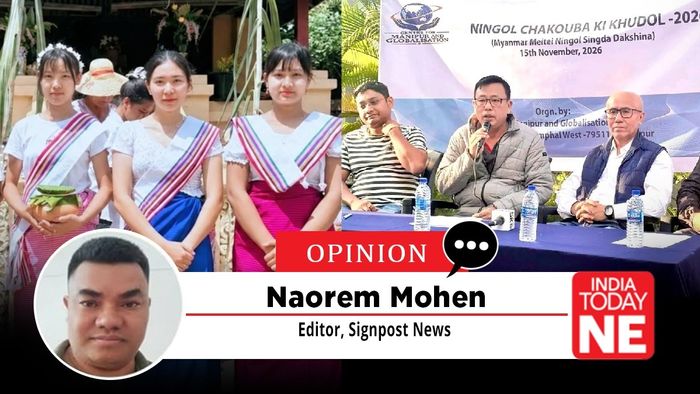
When a married daughter comes home for Ningol Chakouba, her family prepares a meal, gives her gifts and receives her blessings. The invitation is a way of telling her that she still has a place in the home where she grew up. This year, the Centre for Manipur and Globalisation (CMG) marked the occasion by offering phaneks, the traditional wrap worn by Meitei women, as gifts for Meitei women living in Myanmar. For families separated from Manipur for generations, a gift chosen in the spirit of Ningol Chakouba carries a simple message. We remember you, and we want to hear how you are.
Haorokcham Anil, a managing trustee of the Centre, urged people in Manipur to reach out to their Manipuri sisters in Myanmar in whatever way they could. His appeal placed the responsibility on those of us who grew up with the festival. If we brothers do not think of our sisters on Ningol Chakouba, who will? He worried that as the years pass, family ties may weaken to the point where the next generation scarcely knows they exist.
That concern grew out of the Centre’s relief work after the March 2025 earthquake near Mandalay and Sagaing. While assisting affected families, the organisation learned that many Meiteis in Mandalay, Sagaing and Yangon were unfamiliar with Ningol Chakouba. Their unfamiliarity tells us something about when their ancestors left Manipur and what happened to the ties between the two communities in the centuries that followed.
Those ties long predate the present border. Manipur’s royal chronicle records that in 1470, King Kyamba of Manipur and Choupha KheKhomba, the ruler of Pong, undertook a joint military campaign against Kyang. Accounts of their alliance also describe an agreement on territorial boundaries and a royal marriage involving Kyamba’s sister.
More than two centuries later, another marriage alliance, involving Chakpa Makhao Ngambi and the royal court at Ava, renewed links between Manipur and what is now Myanmar. These episodes show how diplomacy and marriage connected the two sides well before war and captivity separated so many Manipuri families from their homeland.
The most painful chapter was the Chahi Taret Khuntakpa, the Seven Years of Devastation from 1819 to 1826. During the Burmese occupation, thousands of Manipuris were killed, driven from their homes or taken captive. One historical reconstruction puts the number taken to Burma in the opening years of the occupation at about 30,000, though accounts differ considerably.
Among those taken were farmers, weavers, carpenters, goldsmiths, horsemen and astrologers. Manipuri horsemen served in the Burmese royal cavalry known as the Cassay or Kathe Horse, while Manipuri specialists also served at the royal court. The skills those people carried into Burma became part of its history, even as their forced departure left an absence in Manipur.
Many Meitei families were already living in Burma when the older custom of Piba Chakouba, in which a sister invited her brother to a meal, took the form commonly associated with Maharaja Chandrakirti Singh, with brothers inviting their married sisters home. Ningol Chakouba became part of community life in Manipur and among Meiteis in Assam and Bangladesh, while many families in Myanmar had left before the festival took its present form.
The separation of British Burma from British India in 1937, followed by Indian independence in 1947 and Burmese independence in 1948, added new political boundaries to a separation that had already lasted generations. After General Ne Win’s military takeover in 1962, state-led Burmanisation increased pressure on minority languages and identities. As Burmese became more important in daily life, some Meitei families found it increasingly difficult to pass Meiteilon on to their children.
For the descendants of those families, Myanmar is home. Known there as Kathe, Meiteis have long-established communities in Mandalay, Yangon and Amarapura, as well as in places such as Homalin, Kalewa, Tamu, Myitkyina and Pyay. Their presence extends across Sagaing and Ayeyarwady regions and into Kachin and Shan states. Some families use Burmese personal names while continuing to pass down their yumnak, the inherited Meitei family name. Even in a household where Meiteilon is seldom spoken, a yumnak can give a child a place to begin asking what the family’s elders remember.
The size of the community remains difficult to establish. A mid-nineteenth-century estimate counted around 25,000 Manipuris in the Burmese kingdom, including captives and their immediate descendants, while another historical estimate put the Meitei population at around 40 thousand in the early twentieth century.
A 2025 estimate placed the community at about 25,000 only. Generations of intermarriage and integration with the Bamar majority complicate any count based on ancestry. The estimates are too different in scope and origin to show how the population has changed over time.
There is much that people in Manipur can learn from the ways these families have carried their heritage. Cultural groups in Mandalay have worked to teach Meiteilon, and in April 2026 members of Myanmar’s Meitei Kathe National Literature and Cultural Association performed Manipuri folk and traditional dances at Mandalay’s Thingyan water festival.
The women for whom the phaneks were intended have stories of their own to share. What did their mothers and grandmothers remember about Manipur? What did they teach their daughters, and what have those daughters made their own in Myanmar? Their answers belong to the history of the Meitei people as much as the festivals we practise in Manipur today.
We often speak of a homecoming as a journey back to a particular place. There is also a kind of homecoming in being remembered by people whose lives have long been separated from ours. If the Centre’s plan to observe Ningol Chakouba in Mandalay next year takes shape, there will be a chance to hear those stories in the place these families call home.
We must not forget the Meiteis of Myanmar when the festival is over. Remembering them means staying in touch in ordinary times and answering when they call for help.
By the time we prepare next year’s feast, may there be a sister across the border whose name we know, whose family we have come to know, and whose call we are waiting to receive.