NRC Before Census: Why Manipur’s Protest Is About More Than a Census
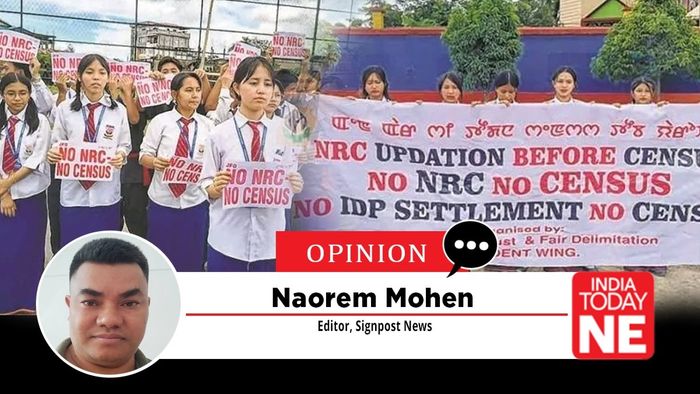
The demand for NRC before Census is not simply an objection to enumeration. It reflects accumulated indigenous anxiety over displacement, demographic change, land, constitutional safeguards and political representation. Manipur’s political leadership should have recognised this before anger reached the streets.
- Aug 19, 2026,
- Updated Aug 19, 2026, 2:15 PM IST
The demand for NRC before Census is not simply an objection to enumeration. It reflects accumulated indigenous anxiety over displacement, demographic change, land, constitutional safeguards and political representation. Manipur’s political leadership should have recognised this before anger reached the streets.
For many in Manipur, the demand for NRC before Census has become the point where several older anxieties meet. It carries questions of indigenous identity and demographic change. It carries unresolved concerns over land, forests, constitutional safeguards and political representation. It also carries the memory of issues that many people believe were allowed to accumulate while successive governments and political representatives responded too late or too weakly.
Seen in this context, the present agitation is not simply a Census controversy. It is an accumulated political question. That is precisely why Manipur’s political leadership should have engaged with it much earlier.
The strongest immediate concern requires no communal framing and no exaggeration. Manipur is still living with mass displacement. More than 40,000 internally displaced persons remain outside their original places of residence.
A Meitei family displaced from Churachandpur or Moreh and presently staying in a relief camp in Imphal may appear in the Census at its present location. Likewise, a Kuki family displaced from Imphal and living in Churachandpur may be recorded there. The document specifically identifies this concern. The resulting numbers may therefore describe where people were forced to live by conflict rather than where communities ordinarily lived before the conflict. We have seen several eligible voters’ name being erased during SIR operations in the State.
A Census conducted while tens of thousands remain displaced risks recording the geography of a conflict rather than the normal demographic geography of Manipur. The question, therefore, is not whether Manipur needs a Census. Of course it does. Census data are indispensable for governance, planning, welfare delivery and development.
The question is whether this is the appropriate demographic moment from which to produce figures carrying long-term consequences. A Census does not end when enumerators finish counting households.
Its figures enter public policy. They influence planning and allocation. More importantly in the present debate, they can later become relevant to delimitation, reservation and political representation.
This is where Manipur’s politicians should pay particular attention. The people protesting today may be carrying placards demanding NRC before Census, but the numbers generated by a Census can eventually enter the political map on which elections are fought. Delimitation can alter constituencies. Population distribution can affect representation. Reservation calculations can influence the electoral structure.
Political leaders therefore cannot behave as though NRC and Census are concerns belonging only to civil society organisations, students or protesters on the streets. They are stakeholders too.
This may be one of those rare public issues where the anxieties of citizens and the long-term interests of elected representatives intersect more closely than present political behaviour suggests. The demographic anxiety behind the agitation also cannot simply be dismissed as a slogan.
Manipur recorded decadal population growth of 35.04 per cent in 1961, 37.52 per cent in 1971 and 24.50 per cent in 2011. For 2011, the corresponding figures presented for India and the world are 17.64 per cent and 10.7 per cent respectively.
Population growth can have many causes. But unusual or changing demographic patterns can legitimately invite examination. That is where the demand for NRC enters the larger public argument. The sentiment behind NRC before Census is essentially this: Manipur should first establish confidence in who constitutes its legitimate demographic population before a new demographic baseline acquires lasting administrative and political consequences.
Whether every claim made during the agitation ultimately withstands verification is a separate question. The underlying concern cannot simply be wished away. The present agitation must also be understood within Manipur’s longer political experience.
Questions surrounding the protection of indigenous land, forest administration, constitutional safeguards, the Manipur Land Revenue and Land Reforms framework, the demand for Scheduled Tribe status for the Meitei community and concerns over migration have all entered public debate at different moments.
People may disagree strongly on the solutions to these questions. They may also disagree on how history, law and policy should be interpreted. But politically, their cumulative effect matters.
When unresolved issues accumulate, the next controversy rarely remains only about itself. That is why NRC and Census have acquired a meaning larger than the two administrative exercises represented by those terms.
For many protesters, this has become a question of whether an indigenous population that fears demographic and political marginalisation will still possess the institutional means to protect itself in the decades ahead. Government cannot answer that anxiety merely by explaining Census procedure. It has to address the political confidence deficit beneath it.
The August 19 order issued by the Sub-Divisional Officer, Lilong, is significant in precisely this context. The order cancelled the Census Training Programme earlier scheduled under an August 17 order. The cancellation may prevent another immediate confrontation. But it also raises an unavoidable question: why was such restraint not exercised earlier, when the depth of public sentiment was already known?
By then, Manipur had already seen memorandums, public appeals, demonstrations and confrontation over the demand for NRC before Census. Students had taken to the streets. Women had joined the protest. A general strike had been called. The warning signs were neither hidden nor sudden.
The government should therefore understand what is being expressed on the streets. This is not a protest for the personal interest of one student, one organisation, one market or one locality. Those participating see it as a question concerning the future of Manipur itself — its indigenous population, land, demography and political representation.
If Census training can be cancelled after tension has already escalated, the question is why the same administrative pause could not have been used earlier to create space for political dialogue. Governance should anticipate a crisis, not wait for a crisis before doing what could have prevented it.
If political representatives genuinely believe that public disruption should stop, the stronger response is not only to say: do not protest. It is to say: let us address the issue producing the protest. That distinction separates political management from political leadership.
Had the government initiated serious consultations earlier, explained its position transparently, engaged organisations raising NRC concerns and examined whether Census preparations should proceed while tens of thousands remained displaced, the confrontation might not have reached its present intensity.
Against this background, BJP Manipur Pradesh leaders and MLAs are reportedly leaving for New Delhi to press the party’s central leadership for intervention on NRC and Census.
Taking Manipur’s concerns to the Centre is legitimate. Matters concerning NRC, Census and related legal or administrative decisions necessarily involve Union-level authority. But there is still a larger political lesson here.
During the past three years, Manipur has repeatedly witnessed a familiar sequence: a problem grows at home, public anger intensifies, confrontation follows, and political leaders eventually travel to Delhi seeking intervention. Delhi cannot become an escape route from political responsibility in Imphal.
The first responsibility of elected representatives is to engage the people they represent. They must listen before anger becomes agitation, explain before rumours become conviction, negotiate before barricades appear and act before administrative decisions require withdrawal.
Going to Delhi after the streets erupt may be necessary. Preventing the streets from erupting through timely political engagement would have been better leadership. The strongest argument emerging from the present controversy is remarkably simple.
The issue is not whether Manipur should ever conduct a Census. The issue is whether a Census conducted amid prolonged displacement, restricted movement, incomplete rehabilitation and unresolved demographic concerns can represent Manipur as it normally exists.
The enumeration under such circumstances could capture the population distribution of a temporary crisis. Those figures may later influence delimitation, reservation, political representation, development planning and administrative decisions. That should be the point around which government, political parties and civil society begin a serious conversation.
NRC must be debated on evidence. Migration claims must be verified rather than assumed. Census remains essential. No community’s demographic existence should be turned into an accusation against another.
But neither should political leadership dismiss the accumulated indigenous anxiety now finding expression through the NRC-before-Census demand. Cancelling one training programme may calm one location. Sending another delegation to Delhi may carry the message farther. Neither, by itself, resolves the question.
Before Manipur counts its people, its political leadership must convince them that the count will reflect the Manipur they actually belong to, not a demographic map temporarily redrawn by displacement, unresolved migration concerns and prolonged conflict.
That is the fundamental question.