On International Day of Peace, Manipur Must Ask: What Does Peace Really Mean?
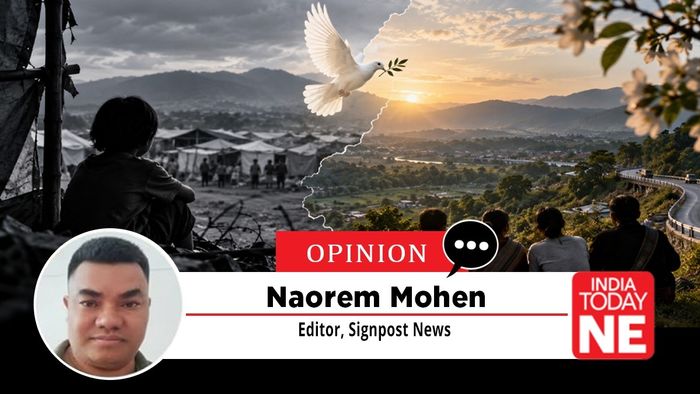
More than three years after violence tore Manipur apart, the question is no longer simply whether the guns have fallen silent, but whether people feel safe enough to live, travel and trust again. On the International Day of Peace, Manipur’s real challenge lies in moving beyond the appearance of normalcy towards a peace rooted in justice, dignity, reconciliation and the ability to live without fear.
- Sep 21, 2026,
- Updated Sep 21, 2026, 11:56 AM IST
Every year on September 21, the world observes the International Day of Peace. There will be messages about harmony, speeches about reconciliation and appeals to end violence.
In Manipur, we should perhaps ask a more difficult question. What does peace actually mean to us today?
For a family still living in a relief camp, peace cannot simply mean that there was no firing last night. For someone who thinks twice before travelling on a National Highway, because of his or her identity, an open highway does not necessarily mean freedom of movement. For a child who has grown up hearing that certain places are unsafe because another community lives there, peace means something much deeper than normalcy.
More than three years have passed since violence broke out in May 2023. Manipur has spent much of that time learning how to manage a conflict. The harder task now is learning how to live together again.
That is why this year's International Day of Peace theme, “Investing in Peace: For Everyone, Everywhere, Every Day,” has a particular meaning for Manipur.
The United Nations asks us to look at peace beyond the absence of war. Peace has to be felt in everyday life — in safety, dignity, opportunity, dialogue and trust.
We need that distinction in Manipur because there is a temptation to mistake a reduction in violence for the return of peace.
The Assembly is functioning. Highways that remained difficult to travel have seen movement again. Political outreach has taken place. Thousands of internally displaced people have been resettled.
These are important developments. We should not dismiss them. But we should also not mistake them for the end of the journey.
On September 3, Chief Minister Yumnam Khemchand Singh told the Assembly that of around 60,000 people displaced by the conflict, about 36,000 had been resettled while around 24,000 continued to live in relief camps.
The first figure gives us hope. The second should make us think. Behind those 24,000 are families. There are parents wondering when they can rebuild their lives, children growing up away from their original homes and people whose livelihoods disappeared with their displacement.
September itself reminded us how fragile the situation remains. Six civilians were killed in fresh violence in the hills. The Supreme Court has also sought details from the state over unnatural deaths reported among people living in relief camps.
So when we say Manipur is returning to normal, we must also ask: normal for whom?
A road may be officially open. But if a citizen is afraid to travel on it because of his community, can we call that peace?
A relief camp may close. But if the people living there cannot return voluntarily and safely to their homes, have we really rehabilitated them?
A market may reopen. But when people who once traded together no longer feel safe meeting one another, something more than commerce has been lost.
This is where normalcy and peace begin to mean different things. Normalcy can be restored through administration. Peace has to return between people. And that is much harder.
Security forces can stop two armed groups from confronting each other. Governments can reopen roads. Courts can demand accountability. Police can enforce the law.
But no security force can order two neighbours to trust each other again. That work has to begin elsewhere — inside villages, schools, universities, markets, churches, temples, civil society organisations and, perhaps most importantly, inside our homes.
For more than three years, almost every community in Manipur has carried its own wounds and its own account of what happened. Those memories cannot simply be erased in the name of peace. Nor should justice be sacrificed for reconciliation.
Victims have a right to know what happened. Families have a right to accountability. Crimes committed during the conflict must be investigated credibly.
Peace without justice will remain fragile. But justice and reconciliation need not be enemies.
We should be able to remember an injustice without teaching our children to hate someone they have never met.
This is where I worry most about Manipur's future. A child who was ten years old when the violence began in 2023 is now entering the teenage years. Three years is not very long for adults. For a child, it is a large part of life.
What are these children learning about Manipur? Are they learning that another community is part of the same society, or are they growing up with invisible maps telling them where they can go and whom they should fear?
If geographical separation continues long enough, it can become psychological separation. A roadblock can eventually be removed. A boundary created inside the mind is much harder to dismantle.
That may become one of the most dangerous legacies of this conflict. This is why investing in peace cannot remain the responsibility of government alone.
Political leaders have a responsibility not to profit from fear. Civil society organisations need to reopen channels of communication. Community leaders need to create room for conversations that may be uncomfortable. Schools and universities have to ensure that young people meet ideas and people outside their own social circles.
The media has a responsibility too. We must report every community's suffering. But suffering should not become ammunition for another round of communal anger. Journalism should expose injustice without making reconciliation more difficult.
And ordinary people have perhaps the hardest responsibility of all: to learn again to see the person before the identity.
None of this means pretending that Manipur's political disagreements do not exist. They do. Some are deep, and some will take years to resolve.
Peace does not require everyone to agree. It requires us to build a society where disagreement does not automatically make another person an enemy.
On this International Day of Peace, Manipur does not need another ceremonial call for harmony. We have heard enough appeals.
What we need now is the courage to ask what kind of Manipur we want to leave behind for the generation growing up after 2023.
One day the guns may fall silent. Checkpoints may disappear. Relief camps may close. Roads may reopen completely.
Even then, our work will not be finished. Manipur will truly begin to find peace when a person no longer has to ask who lives on the other side before deciding whether it is safe to cross the road.
That is the peace worth investing in — for everyone, everywhere, every day.
(The views expressed in this article are those of the author and do not necessarily reflect the views of India Today NE or its affiliates)