Repeating 2001’s Mistakes? The Many Reasons the 2026 Census Cannot Proceed in Manipur
Manipur's 2026 census faces ethnic and political hurdles that threaten its smooth conduct. Authorities need to resolve these issues to ensure accurate population data
- Mar 15, 2026,
- Updated Mar 15, 2026, 8:02 PM IST
The 2001 census in Manipur became infamous for its glaring anomalies, particularly in hill sub-divisions where decadal population growth rates soared to implausible levels, Mao-Maram at around 143%, Paomata at 123%, Purul at 169%, and Chakpikarong showing similar spikes far exceeding natural demographic trends driven by births and deaths.
These figures, widely attributed to possible enumeration errors, migration inflation, or even manipulation amid insurgency and ethnic pressures, prompted immediate backlash.
A state-appointed committee confirmed the irrational increases in these four subdivisions. Following public outcry, court interventions (including Guwahati High Court proceedings), and requests from the Manipur government, the Registrar General of India (RGI) adjusted the growth rate for three Senapati sub-divisions (Mao-Maram, Paomata, Purul) to an arbitrary 39%, effectively excluding or downscaling tens of thousands of people from final reports.
This revision slashed the state's projected population by over 96,000, altered potential assembly seat projections, and sowed deep distrust where many minority communities feared population inflation shifting political power.
Delimitation based on 2001 data was deferred multiple times in the Northeast, including Manipur, due to these unresolved credibility issues. Fast-forward to 2011, and echoes of the same problems resurfaced. Provisional figures showed Senapati district with a decadal growth of about 69.94%, with Mao-Maram at 136.33%, Purul at 120.38%, and Paomata at 99.15%, among the highest across subdivisions nationwide.
An initial low estimate (around 23.8%) was later revoked in a 2014 ruling, accepting the higher numbers without significant objection and publishing them as final. Senapati's population (excluding Kangpokpi) was deemed overestimated yet accepted, perpetuating questions about baseline accuracy.
These unresolved anomalies from 2001 and 2011 form a tainted foundation that any new census risks compounding, especially with delimitation on the horizon post-2026. Proceeding without formally reviewing, correcting, or erasing these historical distortions would legitimise past manipulations while layering fresh inaccuracies atop them.
The current crisis in Manipur, erupting on May 3, 2023, has created even more insurmountable barriers. Prolonged ethnic violence between Meitei communities and Kuki groups has claimed over 300 lives and displaced more than 70,000 people as Internally Displaced Persons (IDPs).
Many remain in relief camps, with relatives, or scattered elsewhere nearly three years later, unable to return due to destroyed homes, lingering threats, or restricted access.
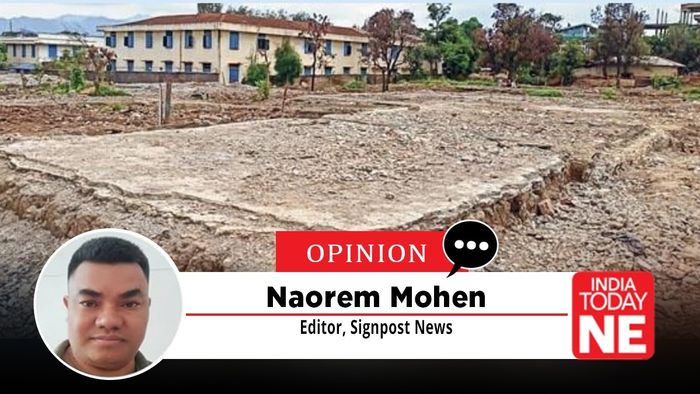
House listing, the census's first physical step, relies on enumerators verifying residential structures and occupants on the ground. But in many areas, homes have been literally flattened like in Churachandpur, burned in Moreh, or abandoned in Langol Game Village, leaving no visible signs that a household ever existed.
Enumerators face blocked roads, community blockades, security risks, and ethnic segregation that prevent safe access to hill-valley peripheries or contested zones.
Where rubble replaces villages, classification becomes arbitrary: marking sites non-existent undercounts displaced populations and erases ancestral ties; using hearsay or old records inflates empty or resettled areas.
Meanwhile, Census guidelines count at the "usual place of residence," but for IDPs, this is ambiguous—camps are temporary, and fears of return persist. Enumerating in camps risks double-counting or origin misattribution; ignoring original sites distorts true demographics.
Congress leader MLA Keisham Meghachandra Singh has moved cut motions in the Manipur Assembly demanding deferral until full IDP rehabilitation and normalcy restore safe enumeration is ensured. Several Civil society groups also warn a rushed process could ignite fresh unrest.
Compounding these ground realities is an incomplete biometric identity infrastructure. Manipur's Aadhaar saturation stands at approximately 82.67% statewide (UIDAI January 2026 data, with around 27.13 lakh live assignments against a projected 32.82 lakh population), well below national averages and insufficient for reliable de-duplication or verification.
Hill districts lag critically, with Senapati and Chandel remaining low-saturation priorities, with Senapati showing only around 43% enrolment of its 285,404 population (excluding Kangpokpi) as of late 2023 figures, and ongoing drives targeting children via Birth Registration Based Aadhaar Enrolment (BRBAE, launched 2026) and school camps.
The state's stringent adult issuance, centralised scrutiny at the Special Secretary (Home) level to prevent fraud, slows progress in remote, conflict-affected hills. Without near-universal linkage (ideally 95%+), census enumeration falls back on self-reporting, vulnerable to errors, double entries, or infiltration, precisely the vulnerabilities that fueled 2001 anomalies.
Administrative irregularities post-2011 further undermine credibility. The 2016 Manipur Gazette No. 408 created 7 new districts and 30 subdivisions (totalling 16 districts, 68 subdivisions), often without proper Revenue/Land & Resources Department norms, justifications (e.g., surrounding locations, village chiefs), or vetting.
The Census Directorate reportedly enumerated unauthorised/unrecognised villages without state approval. Post-2011 villages lack documentation; master directory comparisons with Land Department lists (including inhabited/uninhabited/hamlets) are essential, with markings for changes on maps.
Court cases highlight misreporting or non-inclusion of genuine villages. Without rigorous cross-verification before submission to the RGI, the 2026 census risks incorporating fabricated entities.
Alleged immigration from Myanmar since the 2021 coup amplifies fears. Influxes, refugees and migrants settling in border hills tie into unauthorised villages and demographic shifts. Former CM N. Biren Singh has highlighted the "unnatural" growth of new villages due to illegal immigration. Echoing his voice, several CSOs are demanding identification/deportation via NRC-like mechanisms before the census.
Border districts like Chandel recorded high historical growth (66.62% decadal 1991-2001; sub-divisions like Chakpikarong 100.18%). Without verification, enumeration could entrench shifts, altering ethnic balances and resources. These interlocking factors, physical inaccessibility and IDP crisis preventing accurate house listing; low Aadhaar hindering verification; unresolved 2001/2011 flaws tainting baselines; unauthorised villages and immigration risking unchecked inclusion, make credible enumeration impossible.
Precedents exist like Jammu & Kashmir and Arunachal Pradesh delays. Civil society and leaders urge deferral until the Government of India, in collaboration with the Manipur state administration, prioritises a series of essential preparatory measures before proceeding with any census enumeration in the state.
First and foremost, full rehabilitation of all Internally Displaced Persons must be achieved, accompanied by the complete restoration of normal access and safe movement across the valley and hill areas. Only when displaced families are able to return to their original villages or settlements, rebuild their homes, and live without fear of violence or restriction can a reliable count of households and usual places of residence become feasible.
Second, there needs to be a transparent, independent, and thorough review to formally resolve the long-standing anomalies from the 2001 census, particularly in the four subdivisions like Mao-Maram, Paomata, Purul in Senapati district, and Chakpikarong in Chandel district, where unnatural population growth rates were recorded and later adjusted arbitrarily.
Erasing or correcting these historical distortions through a public, evidence-based process is critical to prevent the new census from inheriting and amplifying flawed baselines.
Third, robust mechanisms for the identification and deportation of illegal immigrants, especially those who have entered from Myanmar since the 2021 coup and settled in border districts, should be implemented, ideally through an updated National Register of Citizens (NRC) exercise or a similar rigorous verification process tailored to Manipur’s context.
This step is indispensable to ensure that census data reflects the genuine resident population and does not inadvertently legitimise demographic changes driven by unauthorised influxes.
Fourth, saturation of Aadhaar enrolment and biometric linkage must be significantly improved, with special focus on the hill districts and the sub-divisions previously flagged for census irregularities, where coverage remains critically low; achieving near-universal biometric verification will provide a reliable tool for de-duplication, identity confirmation, and cleaning of records.
Finally, a rigorous, cross-departmental verification of all villages created or recorded after the 2011 census should be conducted, comparing the Census Directorate’s Master Directory against the official lists maintained by the state’s Land & Resources Department, including checks for proper justification, geographical coordinates, village chiefs, inhabited and uninhabited status, as well as markings of creations, deletions, or name changes on sub-division maps.
Only after these foundational priorities are systematically addressed, ensuring physical accessibility, historical accuracy, demographic integrity, identity verification, and administrative legitimacy, can the census in Manipur be conducted in a manner that produces credible, fair, and trustworthy results capable of serving the state’s people rather than deepening existing divisions.
Deferring the 2026 census in Manipur is not evasion; it is prudence. Rushing risks a "table work" exercise detached from reality, repeating 2001's debacle on a larger scale, and fueling mistrust in a state already fractured. Manipur's people deserve a census that reflects truth, not one that distorts it and exacerbates conflict.