Rice Scam in Churachandpur: Who Ate the Rice Under OMSS (D) Meant for IDPs
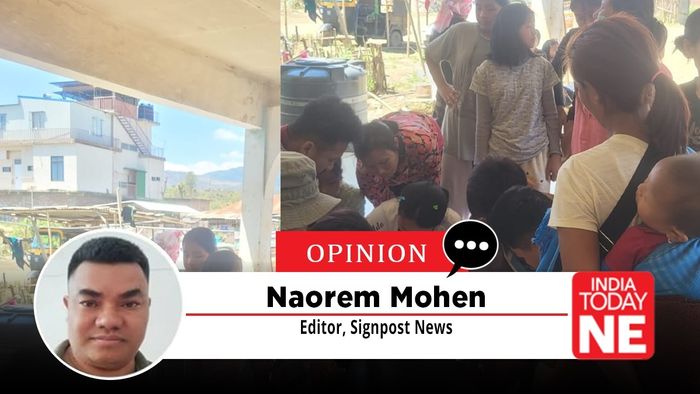
Today, March 23, 2026, more than 130 Internally Displaced Persons (IDPs) residing in five distinct relief camps across Churachandpur district, namely Lanva TD Block, Lingsiphai, Sadbhavana Mandap Relief Camp at Khominthang, Sadbhavana Mandap at KIC Tuiboung, Town Hall Tuiboung, and Community Hall Tuiboung, formally submitted a joint letter to the Deputy Commissioner.
- Mar 23, 2026,
- Updated Mar 23, 2026, 7:05 PM IST
Today, March 23, 2026, more than 130 Internally Displaced Persons (IDPs) residing in five distinct relief camps across Churachandpur district, namely Lanva TD Block, Lingsiphai, Sadbhavana Mandap Relief Camp at Khominthang, Sadbhavana Mandap at KIC Tuiboung, Town Hall Tuiboung, and Community Hall Tuiboung, formally submitted a joint letter to the Deputy Commissioner.
In this poignant and unflinching appeal, the signatories laid bare their ongoing anguish and collective frustration nearly three years after the ethnic violence of May 2023 first forced them from their homes. They declared in clear, unequivocal terms that they have received no rice whatsoever under the Open Market Sale Scheme (Domestic) [OMSS(D)]—the subsidized central mechanism mean for the IDP that permits state governments to procure rice directly from the Food Corporation of India (FCI) on a payment basis, bypassing e-auction entirely.
This was specifically earmarked and made operational for IDP relief purposes from November 2025 onward—since the Direct Benefit Transfer (DBT) system replaced in-kind food distribution on November 1, 2025.
The letter, bearing the signatures of over 130 individuals still confined to these makeshift camps, stands as a powerful, on-the-ground indictment of a profound disconnect between official allocations and actual delivery, highlighting that while the state secured and paid for substantial quantities of OMSS(D) rice explicitly intended for their sustenance, none of it has reached the affected families in these five named locations.
Penned nearly three years into the shadow of the May 2023 ethnic clashes that tore families from their homes, the document captured the raw frustration of lives suspended in limbo. The signatories recounted how the switch to a Direct Benefit Transfer (DBT) system on November 1, 2025, replacing tangible food rations with a daily cash allowance of just ₹84 per person, had plunged them into unrelenting scarcity.
That modest sum, they argued, could scarcely secure enough rice for survival, much less the dal, vegetables, oil, salt, sugar, or emergency medical care their families desperately needed amid soaring local prices and restricted movement.
Most strikingly, they asserted that not a single grain of rice under the Open Market Sale Scheme (Domestic) [OMSS(D)] had ever reached their camps following the DBT transition.
Pointing to the uneven treatment where certain other camps appeared to receive ₹100 per head daily, the letter pressed for urgent redress: immediate delivery of the promised OMSS(D) rice, an upward revision of DBT to ₹100 per person per day, resumption of basic commodity kits, free access to medical services, and smoother pathways to existing welfare programs for widows, senior citizens, schoolchildren, and housing assistance.
This collective voice from the displaced, raw, specific, and signed by over 130 individuals still enduring camp existence, stands in irreconcilable opposition to the detailed bureaucratic record of repeated OMSS(D) procurement requests, advance payments, and authorized liftings documented by Manipur’s Directorate of Consumer Affairs, Food & Public Distribution to FCI from August 2025 through February 2026, amounting to more than 8,300 quintals (approximately 830 tonnes) of rice explicitly earmarked for distribution to Churachandpur’s IDP population.
The rice allocations followed a clear pattern. On August 5, 2025, the Directorate requested 2,000 quintals at ₹2,250 per quintal, with ₹45 lakh deposited upfront via NEFT/RTGS. By December 18, 2025, after a central rate revision to ₹2,320 per quintal (effective November 1, 2025, following a 3% hike aligned with paddy MSP increase), two separate but concurrent indents were issued.
One adjusting an original 2,000 quintals to 1,939.65 quintals (₹44,99,988 deposited) and another additional 929.75 quintals (from an original 1,000 quintals, ₹22,49,995 deposited), explicitly noted as extra monthly supply beyond the regular 2,000 quintals indent.
In February 2026 came two more tranches: 1,457.768 quintals on February 18 (₹33,82,023 deposited) and another 2,000 quintals on February 26 (₹46,40,000 deposited). Each letter named authorized representatives, government officials such as Hatzaw Suanlianpau (SDC/BO, DC Office) and Paul Soilianglal, to lift the stock from FCI godowns in Imphal.
The purpose was stated unambiguously in every communication, that is distribution to the internally displaced persons of Churachandpur district.
However, the IDPs’ March 23 letter insists that from November 2025 onward, precisely when DBT replaced in-kind distribution, not one bag of this OMSS(D) rice arrived at their camps.
The contrast is stark. Full payments made, lifting permissions sought and presumably granted, government nominees designated, yet the camps report zero receipt. This is not a vague allegation; it is a collective, documented complaint from more than 130 people who live the reality every day.
The DBT shift in November 2025 was intended to modernize relief delivery and curb leakages common in in-kind systems. Instead, it sparked immediate backlash.There was also news report of IDPs in Imphal East districts symbolically returned small cash amounts (₹11–12 lakh in some cases) to protest the inadequacy. At ₹84 per day (roughly ₹2,520 per month per person), families struggled to buy even low-quality rice (market prices hovered at ₹50–55/kg), leaving nutrition severely compromised.
In February 2026, the Chief Minister Yumnam Khemchand Singh assured the IDP representatives, and distributed ₹33 crore via DBT, and promised an increase to ₹100 per day (though implementation remained patchy and uneven across camps).
OMSS(D) policy itself, governed by the Ministry of Consumer Affairs, Food & Public Distribution, restricted direct sales to non-surplus states like Manipur for PDS and relief needs. Rates were set at ₹2,250 per quintal until October 31, 2025, then revised to ₹2,320. Separate streams existed: higher-rate e-auction for private traders and lower-rate direct procurement for state governments.
The Churachandpur allocations fell squarely into the latter category, ring-fenced for IDPs. However, from August 2025, Manipur also rolled out OMSS(D) rice for general public mobile sales (₹23–32/kg), creating potential overlap and diversion risk in a logistics-challenged, conflict-affected region.
The core question remains, if payments were made, permissions granted, and nominees authorized, why did the rice never reach the camps?
Several scenarios are plausible, who knows? The rice was lifted but diverted, sold on the black market, redirected to general OMSS public distribution, or quietly allocated to other priorities.
No public exposé has yet pinned these exact tranches to corruption, but the pattern aligns with broader allegations in Manipur’s relief ecosystem, like the siphoned funds, delayed prefab homes, uneven compensation, and persistent grievances over unequal aid between valley and hill districts.
The March 23, 2026 letter is not an isolated complaint; it echoes protests from November 2025, Supreme Court-monitored inquiries into camp conditions (extended into 2026), and repeated memorandums demanding equity and rehabilitation.
In a state fractured by ethnic lines, where trust lies in ruins and security zones enforce separation, the disappearance of over 830 tonnes of subsidized rice meant for the most vulnerable is more than administrative failure—it is a moral indictment.
Meanwhile, the National Food Security Act (NFSA) rice allocations for Antyodaya Anna Yojana (AAY) and Priority Household (PHH) card holders in Churachandpur and Pherzawl districts have similarly failed to reach beneficiaries in full as per the government quota of 5 kg per person per month (free of cost for PHH, and 35 kg per family for AAY under standard NFSA norms).
In Churachandpur alone, official monthly allocations hover around 8,441.70 quintals, while Pherzawl receives approximately 1,212.05 quintals each month, based on the district's ration card population and entitlements under the Targeted Public Distribution System (TPDS). These quotas are meant to ensure food security for vulnerable households through Fair Price Shops (FPS), but complaints from card holders reveal severe shortfalls and irregularities.
A common grievance echoes across the districts: families report receiving far less than entitled. For instance, one family of five members, entitled to 25 kg per month under PHH, has received only 5 kg in some instances, forcing them to stretch meager portions or turn to markets at inflated prices.
Such discrepancies align with broader reports of irregularities in NFSA/PMGKAY rice distribution in Churachandpur, including non-distribution despite lifting from FCI godowns, unauthorized deductions, or diversion by ration agents.
Official records show consistent monthly releases, yet ground-level realities in these hill districts, compounded by ethnic conflict, logistical challenges via alternate routes like Mizoram in earlier periods, and post-2023 displacement—point to systemic leakages, poor monitoring, and failure to verify beneficiary receipts.
In Churachandpur, where many NFSA card holders overlap with IDP populations or face access barriers due to security zones and insecurity, these shortfalls exacerbate the humanitarian crisis already highlighted by the OMSS(D) complaints.
The pattern suggests that while quotas are sanctioned and transported (with historical lifts via Mizoram exceeding 3.22 lakh quintals in prior years), the final mile delivery to FPS and then to households breaks down, leaving vulnerable families, already surviving on inadequate DBT in IDP contexts, deprived of their statutory entitlement to subsidized food grains.
This dual failure in OMSS(D) relief rice and standard NFSA supplies highlight a deeper accountability crisis in public distribution system, demanding immediate audits, transparent FPS-level verification, and corrective enforcement to ensure the law's promise of food security reaches those it was designed to protect.
The IDPs of Churachandpur deserve transparency. Public release of FCI lifting records, transport manifests, camp-level distribution logs, and independent audits tracing every quintal from Imphal godowns to camp beneficiaries.
They deserve immediate action, restoration of in-kind supplies or a meaningful DBT increase, free medical outreach, and credible pathways to safe return or dignified resettlement.
Until the paper trail is matched by food on plates, the question endures: Who ate the rice? The files in Imphal are full; the camps in Churachandpur remain hungry.
The gap between intent and delivery is not abstract, it is measured in empty stomachs and broken trust. The displaced have waited long enough for answers.