Silent Warriors Demanding Justice Through Hunger Strikes in Manipur
In the choking smoke of tear gas shells and lathi charges that have become all too familiar in the streets of Manipur, a group of determined individuals has chosen a quieter yet far more powerful form of resistance. They are silently protesting through mass hunger strike — the most painful and revered form of protest recognised across the world.
Naorem Mohen
- Apr 25, 2026,
- Updated Apr 25, 2026, 12:52 PM IST
In the choking smoke of tear gas shells and lathi charges that have become all too familiar in the streets of Manipur, a group of determined individuals has chosen a quieter yet far more powerful form of resistance. They are silently protesting through mass hunger strike — the most painful and revered form of protest recognised across the world.
This ultimate act of self-sacrifice, where individuals willingly subject their bodies to prolonged suffering without food or water, speaks volumes about the depth of despair and the unwavering commitment to justice in the face of unending turmoil.
Mayanglambam Bobby Meetei from Malom Awang stepped forward first. From April 7 to 11, as President of the People’s Alliance for Peace and Progress Manipur (PAPPM), he sat on hunger strike, refusing food for the sake of his motherland.
Next came Takhellambam Ramananda Meitei from Nongdam. From April 11 to 14, as President of the Village Volunteer Force (VVF), he continued the sacred fast, even as his health deteriorated and he had to be hospitalised.
Then Ahongsangbam Jurist from Uripok took the mantle from April 14 to 18 as Convenor of Youth for Peace and Progressive Manipur (YPPM). Oinam Doren from Oinam Sawombung followed from April 18 to 21 as General Secretary of the Meitei Resurgence Forum (MReF).
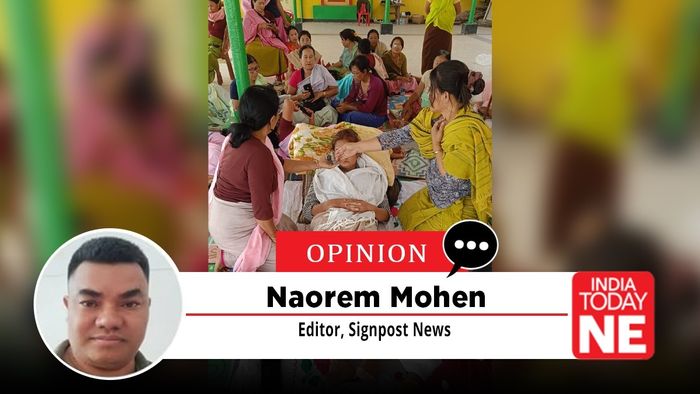
And now, Konsam Nganthoi from Uripok Achom Leikai, a dedicated member of the Uripok Nupi Apunba Lup (UNAL), has been on hunger strike since April 21. Today, April 25, 2026, marks the fifth day of her fast.
These brave sons and daughters of the soil are not seeking personal glory or political gain. They are ordinary citizens of Manipur who have chosen the path of peaceful resistance, laying their bodies on the line through successive hunger strikes to demand justice and lasting peace for their homeland.
One after another, they have endured days without food, their physical strength fading while their determination remains unshaken. The sight of such selfless sacrifice stirs deep concern across the valley, raising urgent questions about how long this cycle of protest and suffering must continue.
Meanwhile, two mothers from Yairipok in Thoubal district — Laikhuram Leirenton, President, and Kongbrailatpam Ongbi Thambalton, Member of the Tampha Keithel Potfam — also began a relay hunger strike on April 23. Several others continue the protest till today.
The pain of Manipur runs deep. Since the outbreak of violence on May 3, 2023, the state has witnessed unimaginable loss — thousands displaced from their homes, hundreds killed, families torn apart, and an entire social fabric left in tatters.
Fresh wounds were inflicted on April 7, 2026, in the Tronglaobi Tragic Incident. A bomb attack in a civilian home near Moirang claimed the lives of two innocent children — five-year-old Tomthin and his five-month-old sister Oinam Yaisana — while critically injuring their mother, Oinam Binita.
What followed was further tragedy when protests led to security forces firing, resulting in three more Meitei civilian deaths. These incidents have left the people grieving, angry, and desperate for answers. The pattern of provocation, violence, and retaliation threatens to engulf the state once again in a cycle that serves no one except those who benefit from continued instability, infiltration, illegal immigration, forest encroachment, and the drug economy.
PAPPM General Secretary Longjam Sanjoy Meitei, while addressing the situation, categorically stated that the Tronglaobi attack was planned by certain elements to deliberately provoke and infuriate the people, aiming to spark mass protests so that more casualties could occur among the Meiteis.
He highlighted that despite a series of agitations and protests since May 3, 2023, little has changed and nothing substantial has been achieved so far. Longjam Sanjoy Meitei called upon all sections of the people to fight collectively under a well-thought-out strategy until justice is delivered, emphasising the need for sustained, coordinated action rather than fragmented responses.
On April 12, 2026, at the historic Malom Awang Ibudhou Pakhangba Community Hall, a significant public discussion was held on the “Tronglaobi Tragic Incident and People’s Movement.” Jointly organised by the People’s Alliance for Peace and Progress Manipur (PAPPM) and the Meira Paibees from Malom to Meitram, the gathering brought together civil society organisations, torch-bearing mothers, and concerned citizens from across the valley.
After extensive deliberation on the escalating cycle of violence, the assembly adopted a Public Declaration and Resolution, giving birth to the People’s Movement for Justice and Peace — a non-violent, non-ethnic, centrally coordinated civil disobedience movement.
This movement is grounded in five core principles like absolute non-violence, central command and coordination, targeting flawed government policies rather than any community, complete transparency and documentation, and the spirit of self-sacrifice without retaliation.
These principles reflect the mature and responsible approach of the people even amid profound provocation and suffering. At the core of the movement stand the Nine Demands, unanimously adopted by the participants. These demands represent the collective voice of the people and address the root causes of the ongoing crisis.
Justice Against Terrorism
The militants responsible for the Tronglaobi bomb attack and all similar attacks must be arrested and prosecuted under the Unlawful Activities (Prevention) Act (UAPA) as clear acts of terrorism.
Protection of Villages
Sufficient security forces must be deployed to safeguard all vulnerable villages from militant attacks, allowing residents to live without constant fear.
Removal of Illegal Encroachments
All illegal encroachments in reserved forests, protected forests, wildlife sanctuaries, and wetlands must be evicted based on verified satellite imagery and ground surveys. The ecological heritage of Manipur cannot continue to be sacrificed.
Eradication of Illegal Poppy Cultivation
Satellite mapping must be undertaken to completely eliminate illegal poppy fields, with the arrest of those responsible, including financiers and protectors. This deadly crop continues to poison the youth, the economy, and the future of the state.
Transparency on Illegal Settlements
The government must publish complete data on the rise of illegal villages since 1951 and expose all fraudulent recognitions, including revenue records and Scheduled Tribe status granted without proper authorisation.
NRC Update for Manipur
The National Register of Citizens (NRC) must be updated with a clear cut-off date of 1951 or 1961. No citizenship rights or ST benefits should be extended to post-cut-off entrants, safeguarding the indigenous identity of the state.
Recognition of Terror Acts
The authorities must officially acknowledge that the May 3, 2023 attacks and subsequent bombings, including the Tronglaobi incident, constitute acts of terrorism against civilians, often aided by foreign forces, and not mere “ethnic clashes” or routine “law and order problems.”
Accountability Through Judicial Inquiry
A time-bound, independent judicial inquiry must be established into the Tronglaobi bomb attack and the deaths of civilians in CRPF firing. Those found guilty — whether militants or security personnel — must face prosecution without fear or favour.
Rehabilitation of IDPs
All internally displaced persons must be resettled in their original homes and villages with full restoration of houses, agricultural lands, and livelihoods, accompanied by adequate security to prevent further displacement.
The above nine points declaration carries a powerful message: “We seek justice, not revenge. We seek peace, not surrender.”
They further resolved to form an Interim 11-member committee to engage state-level civil society organisations and initiate the formation of a United CSO Leadership Council.
The mass hunger strike will continue until this council is established and the movement is formally launched, or until the nine demands receive sincere attention from the state government.The call has gone out to all state-level civil society organisations, Meira Paibees, youth groups, and intellectuals to come forward, unite, and provide leadership to this peaceful struggle.
The time for fragmented responses has passed; the moment for coordinated, principled action has arrived.Manipur has endured years of unimaginable suffering. The resilience shown by the people in choosing non-violent democratic protest, even after repeated tragedies, stands as a testament to their civilisational strength and moral character.
The successive hunger strikes by young leaders from different organisations highlight a shared commitment to justice that transcends individual or group interests.
The government, both in Imphal and New Delhi, now faces a critical responsibility. These demands are not directed against any community but against terrorism, illegal activities, unchecked encroachment, drug mafias, and policies that undermine the security and identity of the indigenous people.
Timely and honest action on these points has the potential to de-escalate tensions and lay the foundation for genuine peace which the current CM Yumnam Khemchand has been advocating. Continued delay, however, risks deepening despair and prolonging the cycle of pain that has already claimed too many innocent lives.
The ongoing hunger strike, torch rallies, shutdowns, and growing public sentiment serve as clear signals of the people’s anguish and determination. The patience of a grieving society has its limits. The tragic loss of young children in Tronglaobi and the subsequent civilian casualties have left deep scars that demand accountability and concrete steps toward healing.
It is therefore, time for the Chief Minister, the Union Home Minister, and the Prime Minister to intervene with urgency. Establishing the judicial inquiry without further delay, initiating visible measures on the nine demands, and engaging directly with the fasting individuals would demonstrate genuine concern for the suffering of the people.
The frail bodies and fading strength of those on hunger strike represent the silent cry of an entire population that has borne too much for too long. Their sacrifice must not be allowed to end in further tragedy.
The brave hunger strikers — Mayanglambam Bobby Meetei, Takhellambam Ramananda Meitei, Ahongsangbam Jurist, Oinam Doren, Konsam Nganthoi, and those who stand with them — embody the unyielding spirit of a people who refuse to surrender their hope for justice and peace.
History will remember this moment not for the violence that has plagued the state, but for the dignity with which its people have chosen to resist.
MORE NEWS
Read more!