The Human Tragedy of Assam's NRC and the Lessons Manipur Must Not Ignore
The story of Assam’s National Register of Citizens is filled with profound sadness and urgent concern. What began as a necessary effort to honour the Assam Accord of 1985 and safeguard the demographic, cultural, and linguistic character of Assam from unchecked illegal immigration ultimately became one of the most heartbreaking administrative failures in recent Indian history.
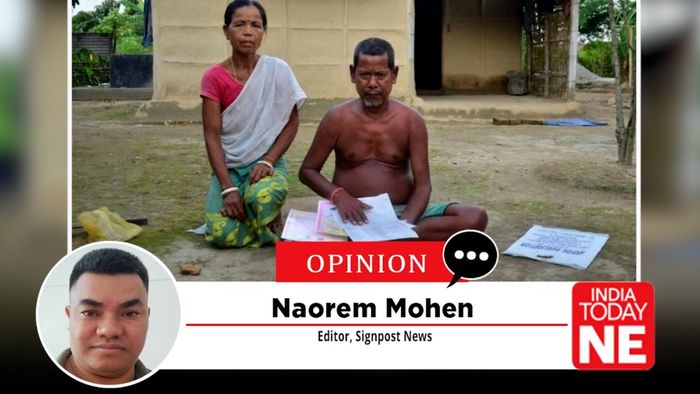
- May 01, 2026,
- Updated May 01, 2026, 6:04 PM IST
The story of Assam’s National Register of Citizens is filled with profound sadness and urgent concern. What began as a necessary effort to honour the Assam Accord of 1985 and safeguard the demographic, cultural, and linguistic character of Assam from unchecked illegal immigration ultimately became one of the most heartbreaking administrative failures in recent Indian history.
The final list published in 2019 left nearly 1.9 million people excluded out of 32.9 million applicants. Behind those cold statistics lies a trail of fear, despair, broken families, and over fifty documented suicides by March 2024. The process exposed the deep fault lines in how we approach citizenship verification when large sections of the population live in poverty, face annual natural disasters, and possess almost nothing in terms of formal documentation.
For Manipur, now grappling with its own demands for a similar exercise amid ethnic tensions and concerns over cross-border inflows, Assam’s experience is not a distant case study but a mirror that demands honest confrontation.
The fundamental failure of the Assam NRC stemmed from its rigid over-reliance on legacy documents in a society ill-equipped to meet such demands. The procedure required List A documents—proof that the individual or their ancestors resided in Assam before the March 24, 1971 cutoff—such as entries in the 1951 NRC, pre-1971 electoral rolls, land and tenancy records, citizenship certificates, passports, or government-issued licences.
List B linkage documents then had to connect the applicant to those ancestors through birth certificates, school records, or Gram Panchayat certificates.
On paper, this seemed logical. In reality, it was cruelly disconnected from ground realities. Assam is a land ravaged by the Brahmaputra’s annual floods. Villages disappear, homes are destroyed, and whatever little paperwork poor families manage to keep is washed away in the muddy waters.
A daily-wage labourer living in a temporary hut, moving from one worksite to another in search of survival, has no capacity to preserve decades-old documents. How can a family that rebuilds its shelter every monsoon season produce clear land records or consistent electoral roll entries?
Record-keeping in rural areas was never meticulous, and many genuine citizens, especially from marginalised and migrant backgrounds within the state, lacked knowledge of procedures or even awareness that such documentation would one day determine their very right to exist as Indians.
Officials often rejected ration cards—akin to social security proofs—on flimsy technical grounds, even when the Supreme Court had indicated they could serve as linkage evidence. Spelling mismatches, minor discrepancies in names after marriage, or simple non-acceptance became reasons for exclusion. This created an atmosphere of arbitrariness where executive discretion reigned supreme.
Compounding this was the excessive power handed to officials at every level. A state-level committee and the NRC Coordinator oversaw around 52,000 subordinates who conducted verifications and drew up family trees. Without clear, uniform criteria for distinguishing “original” from “non-original” inhabitants, these authorities divided the population in ways that felt deeply biased and opaque.
The “non-original” were subjected to disproportionately strict scrutiny despite possessing documents, while some others received leniency. Parallel mechanisms worsened the chaos. Electoral Registration Officers and Border Police could mark individuals as Doubtful Voters and refer them to Foreigners Tribunals, even after NRC inclusion.
Tribunals themselves operated with summary procedures—giving suspects just ten days to reply and present evidence—while being presided over by advocates, retired officials, or contractual staff with minimal training. Allegations surfaced that some tribunal members felt pressured to rule against applicants to secure contract renewals.
There was no uniformity, no robust safeguards against bias, and no real finality. Anyone could file objections against inclusions without penalties for frivolous complaints, dragging families through repeated cycles of anxiety and litigation.
In a state where India has no extradition treaty with Bangladesh, those declared foreigners faced the prospect of indefinite detention, stripping them of substantive rights and reducing them to legal ghosts. The judiciary, including the Supreme Court, largely refrained from deep intervention despite being aware of these flaws, treating the Assam case as an exception rather than addressing systemic issues.
The human cost of this flawed machinery was devastating and remains seared in memory. Fear of exclusion, loss of voting rights, jobs, education access, and Aadhaar linkage created a mental health crisis. Saibun Nesha Laskar, a 45-year-old Muslim Bengali woman from Sonai in Cachar, failed to gather legacy data and committed suicide in July 2015, torn apart by the dread of deportation.
Hanif Khan, a 40-year-old driver from Kashipur, hanged himself in January 2018 after his name did not appear in the first draft. Ratan Ray, working with the government’s inland water transport authority in Guwahati, took his life in April 2018 when his name was missing initially.
Entire families suffered, Deben Barman saw his son and grandchildren excluded while others were included, leading to his suicide. Subrata Dey, despite his family’s presence in the 1951 NRC, was declared a foreigner, sent to a Goalpara detention camp, and died there after two months, leaving his poor family without their only earner.
Laifon Ali, an elderly man marked as a D-voter despite having documents, ended his life out of detention fears. Retired teachers like Bimal Ch. Ghosh and Nirod Boron Das, who had even worked on the process, succumbed to depression when excluded. The list goes on—Angad Sutradhar, Jamir Khan, Aklima Bewa, Anowar Hussain, and many more—spanning Hindus, Muslims, tea tribes, and Gorkhas.
Women and children suffered the most under Assam’s NRC. Married women often faced rejection due to name and address changes after relocation, struggling with mismatched documents and restricted linkage proofs like Gram Panchayat certificates.
Many depended on male relatives’ records and were hit hardest by “strict verification” rules. Children suffered when a single parent’s Doubtful Voter status or tribunal case tainted their applications, leaving them at risk of being declared foreigners despite being born in Assam.
Scarce school and birth records in flood-affected poor areas worsened their plight. This uncertainty triggered family stress, disrupted education and healthcare, and contributed to the wave of despair and suicides. Their silent trauma remains one of the exercise’s most unforgivable failures, highlighting how rigid documentation ignores gendered and generational vulnerabilities.
These were not just statistics but living people crushed by complexity, economic ruin, and the terror of becoming stateless in the only home they had ever known. Women and transgender applicants faced added burdens due to name and address changes. The absence of any built-in mental health support or grievance mechanisms turned procedural stress into fatal despair.
A 2022 CAG audit later revealed massive irregularities, cost escalations from ₹288 crore to over ₹1,600 crore, software failures, and verification lapses, confirming what victims already knew: the system was not designed for the realities of the poor and disaster-affected.
Political and administrative pressures further undermined the process. The ruling dispensation at times pushed for stricter outcomes, while opposition voices highlighted disenfranchisement of genuine citizens. Even within the BJP, some ministers reportedly expressed unhappiness with the implementation.
The All Assam Students’ Union, a key player in the original movement, pointed out deficiencies. Harsh Mander’s observations as a special monitor for the National Human Rights Commission revealed how due process was neglected—district administrations taking months to provide documents while tribunals gave applicants mere weeks.
India’s lack of repatriation arrangements meant declared foreigners languished in camps, turning a citizenship exercise into a humanitarian tragedy. Porous borders remained unaddressed, making the entire costly effort feel incomplete as infiltration concerns persisted.
Legacy data itself carried inherent flaws: documents from earlier decades were issued under loose regulations for welfare purposes, opening avenues for forgery, yet the system treated them as infallible while punishing those without access.
The NRC conflated contested citizenship with confirmed illegality, creating confusion even in family trees where one parent’s status tainted descendants.These failures were not mere administrative oversights but a profound disconnect between policy intent and lived reality.
In a low-documentation society marked by poverty, illiteracy in procedural matters, frequent disasters, and migration for survival, demanding exhaustive proofs without adequate support systems was bound to exclude the vulnerable.
The process lacked transparency, timely public information drives, fast-track facilitation for document recovery, and penalties against abuse. It divided society rather than unifying it around shared citizenship. Genuine indigenous voices also suffered harassment, diluting the very protection the exercise aimed to provide.
The moral question remains heavy, how does a nation balance its duty to native communities against the rights of long-settled residents and the imperative of humane governance? Assam’s NRC tilted too far toward rigidity, paying the price in human lives and eroded trust.
For Manipur, the parallels strike with alarming force. Our state has seen homes and documents burned in ethnic violence, leaving thousands of IDPs—many indigenous daily-wage families without proper shelter—in camps where survival itself is a daily battle. Fire and conflict have destroyed what little they possessed.
Imposing a similar documentation-heavy NRC without deep reforms would repeat Assam’s mistakes on even more fragile ground. We must learn that protecting indigenous identity requires more than lists and proofs. It demands a compassionate framework: relaxed standards for IDPs and the poor, community-based verifications, state-supported reconstruction of records, mental health integration, and priority on border security alongside the exercise.
Broad consultations across communities, transparency, and finality are essential. However, Manipur has advantages—a smaller population, the Inner Line Permit system, and potential for a clearer base year—but only if we design the process to include every genuine son and daughter of the land, not exclude them for circumstances beyond their control.
Assam’s NRC was a warning written in tears and lost lives. Its failures—rooted in unrealistic documentation demands, unchecked discretion, lack of support for the vulnerable, procedural opacity, and disregard for disaster-affected realities—must guide Manipur toward wisdom.
We cannot afford to let poverty, floods, or conflict become barriers to belonging. True indigenous protection means ensuring no one is erased simply because they never had the luxury of preserving papers while fighting for daily survival.
As demands for an NRC grow louder amid legitimate concerns over illegal immigration and indigenous rights, the path forward lies not in hasty replication but in thoughtful collaboration. Civil Society Organisations must sit together with the government in open, inclusive discussions to design a successful and purposeful NRC tailored to Manipur’s unique realities.
This joint effort should prioritise minimum pressure on indigenous people — especially the poor, daily-wage families, IDPs, and women — through relaxed yet credible standards, community-based verifications, state-supported document reconstruction, mental health safeguards, and a clear focus on border security first.
Only through such empathetic, transparent dialogue can we create a process that truly protects our land, culture, and identity without erasing the most vulnerable among us.
Manipur has the opportunity to rise above Assam’s mistakes and build a model that values both security and humanity. Let us seize it together, ensuring every genuine indigenous voice is heard and no one is left behind in fear or exclusion.