The Kuki CSO’s Victim Card Has Worn Thin After Tiger Road Ambush
On 13 May 2026, around 10:25–10:30 a.m., gunmen ambushed two vehicles carrying leaders of the Thadou Baptist Association India (TBAI) on the Imphal-Tamenglong highway, locally known as Tiger Road. The attack occurred between Kotzim and Kotlen villages in Kangpokpi district — a region under Kuki-dominated influence with notable militant presence despite central forces deployment.
- May 19, 2026,
- Updated May 19, 2026, 4:54 PM IST
On 13 May 2026, around 10:25–10:30 a.m., gunmen ambushed two vehicles carrying leaders of the Thadou Baptist Association India (TBAI) on the Imphal-Tamenglong highway, locally known as Tiger Road. The attack occurred between Kotzim and Kotlen villages in Kangpokpi district — a region under Kuki-dominated influence with notable militant presence despite central forces deployment.
The victims were returning from a United Baptist Convention meeting held in Churachandpur.The three church leaders killed in cold blood were: Rev. Dr. Vumthang Sitlhou, TBAI President and former General Secretary of the Manipur Baptist Convention; Rev. Kaigoulen Lhouvum, Finance Secretary; and Pastor Paogoulen Sitlhou. Four more individuals sustained injuries.
These were respected Thadou spiritual and community leaders who had consistently emphasised their distinct Thadou identity and advocated for dialogue across ethnic lines. Thadou Inpi Manipur promptly described them as Thadou martyrs and firmly rejected attempts to subsume them under a broader “Kuki” label — a classification they had not accepted during their lifetimes.
Three years have passed since 3 May 2023, when the Tribal Solidarity March triggered widespread violence that engulfed Manipur in a cycle of destruction, loss of lives, and mass displacement affecting every community.
From that day until 3 May 2026, the state has witnessed not only inter-community clashes but also emerging fractures within the hills. Recent incidents reveal a troubling pattern of selective narratives, rapid blame-shifting, and the persistent use of victimhood to shape public perception while avoiding accountability.
In this context, the victim card played by certain Kuki civil society organisations (CSOs) appears increasingly strained and unconvincing.
Kuki Inpi Manipur (KIM) issued a condemnation shortly after the incident, pointing fingers at ZUF (Kamson faction) and NSCN-IM. This response raises legitimate questions about logic and timing. The ambush took place in an area where Kuki militants maintain significant control, near a Kuki militant group's tax collection gate and close to security posts. External infiltration by non-local groups would be extremely difficult.
The United Naga Council (UNC) has strongly challenged the KIM statement, noting that it was dated 6 May 2026 — seven days before the actual incident — with no corrigendum issued.
According to the UNC, this indicates the statement was pre-drafted and released almost immediately after the event, mirroring tactics observed since the violence began on 3 May 2023.
The UNC has demanded that KIM provide concrete, public evidence of Naga involvement rather than unsubstantiated allegations.This incident fits a concerning pattern regarding Thadou leaders who resist absorption into a single narrative framework.
Their desire to preserve a distinct identity appears to have made them targets, both in life and in the way their deaths are framed afterward.
The 2026 ambush echoes a similar tragedy from the previous year. On 30 August 2025, Nehkam Jomhao, aged 59 and Chairman of the Thadou Literature Society, Assam, was abducted from his residence at Chonghang Veng, Manja area, Karbi Anglong district, Assam, around 7:30 p.m. He was brutally tortured and murdered, with his body later recovered from a river. Suspects linked to Kuki Revolutionary Army (KRA) and allied elements were arrested in connection with the case.
Nehkam Jomhao’s only apparent “fault” was his active participation in the “Road to Peace – Covenant of Community Understanding” meeting on 6 August 2025 in Imphal, where Thadou Inpi Manipur engaged with Meitei civil society organisations.
Like the TBAI leaders returning from a Christian gathering in 2026, he had chosen dialogue and identity preservation over forced alignment. The UNC has referenced this earlier killing while criticising the latest allegations, exposing a recurring pattern of targeting Thadou voices who do not submit to supremacy expectations.
The posthumous rebranding of such victims as “Kuki” raises serious questions about motives — whether it serves to deflect responsibility or reshape narratives for external sympathy.
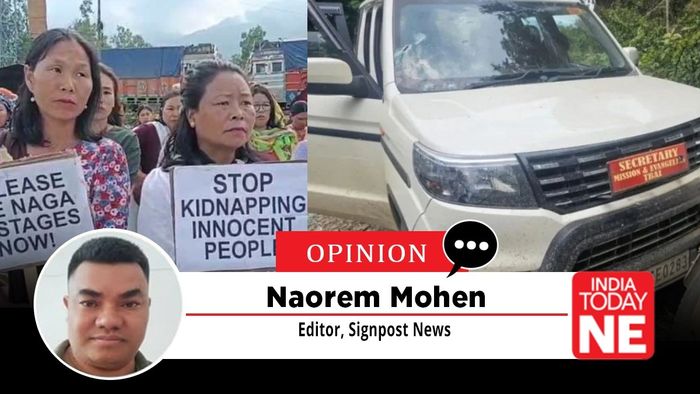
The ambush and immediate accusations triggered a wave of abductions between communities. Incidents occurred in Kuki majority areas of Kangpokpi district and Naga-majority Senapati district.
Residents from Konsakhul (a Liangmai Naga village) and surrounding areas were taken shortly after news of the attack spread and Kuki groups began alleging Naga responsibility.
Naga groups responded by holding individuals from Taphou and nearby Kuki villages.A partial resolution came on Friday morning, 16 May 2026, when both sides released 14 captives each following a day-long stand-off. Yet the situation remains highly volatile.
Naga groups report that six Naga men are still unaccounted for, allegedly held by Kuki elements. These include Reverend Manu Thiumai, a pastor from Harup, and five residents of Konsakhul.
Notably, the abductions occurred near the Leimakhong military station — the state’s largest garrison — raising concerns about response times. United Naga Council President Ng Lorho and leader Thotso have expressed deep worry over the missing men’s status, stating that clarity is needed before further releases.
They emphasise that their people are holding some Kuki individuals only until the six Nagas’ fate is established.
On the other side, 14 Kuki individuals — mostly men from Taphou (including three students) and one from Hengbung — remain in Naga custody in Senapati. The Kuki Students’ Organisation, Sadar Hills, issued a 48-hour ultimatum on Sunday evening, threatening widespread agitation if they are not released.
Janghaolun Haokip, Information Secretary of Kuki Inpi Manipur, has publicly stated that all hostages in their custody were released, they have no information about the six missing Nagas, and they are relying on government and security forces for rescue operations. Security officials have confirmed ongoing search efforts in Kangpokpi and neighbouring areas.
Meanwhile, Kuki civil society organisations, including KIM, have used media platforms and church networks to project a victim narrative. They have called for President’s Rule and separate administration, invoking shared Christian faith and appeals for peace.
While highlighting their own minors, students, and civilians, there has been comparatively less emphasis on other unresolved cases, such as Meitei students abducted since 2023 whose remains are still untraced.
The contrast between these appeals and the retention of hostages on both sides, coupled with the pre-drafted statement, appears inconsistent to many observers familiar with the ground realities.
What stands out most starkly is the complete absence of any demand for justice from the Kuki side for the slain Thadou pastors. While every major Thadou organisation — including Thadou Inpi Manipur and the Thadou Baptist Association — has repeatedly called for the case to be handed over to the National Investigation Agency (NIA) for an impartial probe, not a single word has come from Kuki Inpi Manipur or other Kuki CSOs seeking justice for these Thadou leaders.
Instead, they have used the deaths of these very Thadou martyrs to intensify their demands for President’s Rule and separate administration. Demonising the Naga community, issuing pre-drafted statements, and continuing to play the victim card may generate temporary noise and sympathy in certain quarters, but it yields no real results. The hypocrisy of Kuki CSO leaders is now visible to all who have followed Manipur’s painful journey over these three years.
After three years of unrelenting lies and propaganda, the Kuki's victim card has worn dangerously thin. The blood trail from the Tiger Road ambush, the cold-blooded murder of Nehkam Jomhao in Assam in 2025, and the lingering hostage tensions expose a familiar playbook, one that relies on selective outrage, pre-drafted accusations, and posthumous identity theft.
The repeated attempt by Kuki CSOs to cast their community as perpetual victims, while systematically sidelining inconvenient truths, has now lost whatever persuasive power it once held.
For three long years — from the outbreak of violence on 3 May 2023 to the present — this carefully crafted narrative has been deployed again and again. Quick blame on others, rapid appeals to Christian solidarity, demands for President’s Rule and separate administration, and the strategic rebranding of slain Thadou leaders as “Kuki martyrs.”
Yet the ground realities refuse to stay hidden — the ambush in a tightly controlled Kuki-dominated stretch of Tiger Road, the pre-drafted statement dated days before the incident, the cold-blooded killing of Nehkam Jomhao in 2025 for the “crime” of preserving Thadou identity, the selective silence on demands for NIA investigation, and the ongoing hostage discrepancies.
The people, having endured displacement, loss, and broken trust across communities, can no longer be swayed by one-sided press releases and church appeals that ignore their own role in the cycles of violence.
The victim card, played too often and too selectively, now appears not as a cry for justice but as a familiar tactic to deflect scrutiny and advance political goals. After three years of blood and suffering, the mask has slipped.
The public sees the pattern clearly, and orchestrated victimhood can no longer substitute for accountability and honest dialogue.
(The views expressed in this article are those of the author and do not necessarily reflect the views of India Today NE or its affiliates.)