Time for CM Yumnam Khemchand Singh to Prioritise Healing Over Ceremony
Today, the circumstances before Chief Minister Yumnam Khemchand Singh are different in nature. The opposition came not from armed insurgents targeting him personally, but from ordinary citizens — mothers, fathers, youths, and elders — carrying the unbearable burden of repeated civilian tragedies, including the deaths of the two children and the three Meitei youths in Tronglaobi.
- Apr 21, 2026,
- Updated Apr 21, 2026, 5:06 PM IST
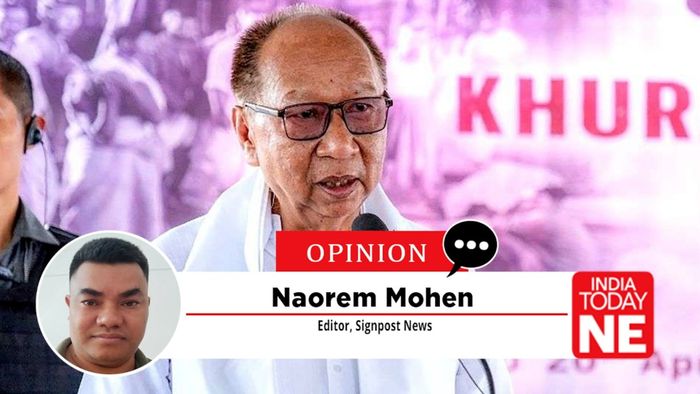
Today, Tuesday, April 21, 2026, Manipur Chief Minister Yumnam Khemchand Singh proceeded with his visit to Wangjing in Thoubal district and successfully inaugurated the newly constructed Block Development Office (BDO) of the Wangjing Tentha CD Block. Despite widespread protests that had begun since yesterday and strong appeals from several Meira Paibi groups and local organisations to postpone the event in view of the deep grief prevailing across the state, the Chief Minister went ahead with the programme.
Because protestors had blocked the roads since early morning, CM Khemchand had to travel to Wangjing by Indian Army helicopters. After completing the inauguration successfully with tight security arrangements in place, he returned to Imphal in the afternoon. The BDO office has now been formally handed over to the people. That is a welcome and positive development — infrastructure meant for public service belongs to the people, and its completion fulfils a genuine aspiration of the residents of Wangjing, who now have their own proper government office at the grassroots level.
Yet, as the function concluded and the Chief Minister returned safely, one question continues to weigh heavily on the hearts of many across the hills and valley of our beloved Manipur: Will the people now wholeheartedly bestow their blessings upon the government? Or will this inauguration, conducted under such tense circumstances, stand as yet another symbol of the growing disconnect between those in power and the collective pain that refuses to subside?
The protests were not born out of thin air or personal animosity. They drew their strength from two fresh, heartbreaking tragedies — and the unbearable layers of grief that followed — that have torn at the conscience of our land. On the night of April 7, 2026, a horrific bomb explosion ripped through a civilian home in Tronglaobi Awang Leikai near Moirang in Bishnupur district. Two innocent children — five-year-old Oinam Tomthin and his five-month-old sister Oinam Yaisana — were sleeping peacefully when the blast claimed their young lives in an instant. Their mother, Oinam Binita, suffered critical injuries and fought for survival in the hospital. Their father, serving far away in BSF, returned to a family shattered beyond words. The cold-blooded killing of sleeping children shakes the very foundation of humanity. No ideology, no “struggle,” no political cause can ever justify such brutality against the most innocent and vulnerable.
What followed only deepened the wound. As angry protests erupted in the area, a mob stormed a nearby CRPF camp in Tronglaobi Maning. In the ensuing chaos, three Meitei youths were killed when CRPF personnel opened fire. These young lives were lost amid the outpouring of grief and rage over the children’s deaths. The incident left many more injured and added fresh trauma to an already grieving community. The pain of the two little children taken away in their sleep, combined with the loss of these three youths at the hands of security forces, has left an entire section of our people feeling abandoned and unheard.
Then, on April 18, 2026, another tragedy struck near T.M. Kasom village along National Highway 202 in Ukhrul district. Two Tangkhul Naga civilians — retired soldier of the Naga Regiment, SW Chinaoshang (46) from Tashar village, and civilian Yaruingam Vashum (42) from Kharasom village — were ambushed and killed in broad daylight while travelling from Imphal. These were ordinary men going about their daily lives, not combatants. Their deaths plunged entire families and the wider Tangkhul community into profound mourning and renewed anger. Once again, innocent blood was spilled on our public roads, deepening fear, suspicion, and the dangerous cycle of mistrust between communities.
It was against this backdrop of raw, multi-layered grief and a loud demand for justice and accountability that sections of the public, particularly Meira Paibis from Thoubal district, took to the streets yesterday and today. They urged the Chief Minister not to proceed with the inauguration, arguing that routine celebrations feel out of place while Manipur continues to bleed — with mothers mourning their babies in Tronglaobi and families grieving their sons and civilians across communities. During the protests, one demonstrator, Elangbam Nandabir (42 years) from Heirok, was injured when security forces used live rounds along with tear gas shells to disperse the crowd. He is currently undergoing treatment and, thankfully, is not in mortal danger. Still, every bullet and every injury only adds to the prevailing sense of pain, alienation, and resentment.
Such moments naturally invite us to reflect on our recent history. We remember the Ukhrul saga of October 24, 2016. Then Chief Minister Okram Ibobi Singh had arrived by helicopter to inaugurate a hospital and other facilities in Ukhrul. As he alighted near the helipad, suspected NSCN(IM) cadres opened fire. Bullets rang out dangerously close. Two Manipur Rifles jawans were injured, but there was no civilian collateral damage. Ibobi wisely chose to cut short his visit and return immediately to Imphal. At that time, many voices — especially from the valley — criticised him harshly, labelling him a weak and timid Chief Minister who could not assert his authority even in his own state.
Today, the circumstances before Chief Minister Yumnam Khemchand Singh are different in nature. The opposition came not from armed insurgents targeting him personally, but from ordinary citizens — mothers, fathers, youths, and elders — carrying the unbearable burden of repeated civilian tragedies, including the deaths of the two children and the three Meitei youths in Tronglaobi. In such a sensitive and emotionally charged atmosphere, true leadership often reveals itself not in pushing ahead with a scheduled programme at all costs, but in demonstrating empathy by reading the wider public pulse and choosing restraint when the moment calls for it. Postponing the event could have sent a powerful message of solidarity with grieving families across communities — Meitei mothers in Bishnupur mourning their children and lost youths as well as Tangkhul families in Ukhrul mourning their loved ones.
Nevertheless, the Chief Minister decided to go ahead. He travelled by Army helicopters due to the road blockade and completed the inauguration successfully. The BDO office now stands handed over to the people of Wangjing — perfect in its administrative sense. Local aspirations for better governance and faster service delivery at the block level have been addressed, at least symbolically. Yet we must never forget that development without peace is like planting a tree in parched and unstable soil. It may appear promising for a while, but it struggles to take deep root and bear fruit without the foundation of trust and collective healing.
A Chief Minister of Manipur in these troubled times cannot afford to be seen as the leader of only a section of the people or only those pockets where the welcome is warm. He must strive, with sincerity and courage, to become the Chief Minister of all — every Meitei, every Naga, every Kuki-Zo, every Pangal, and every smaller community that calls this wounded yet beautiful land home. He must feel the agony of a mother who lost her little children in a midnight bomb blast and the pain of families who lost their young sons in the subsequent firing in Tronglaobi as deeply as he feels the sorrow of families mourning their loved ones ambushed on the highway. Inclusiveness is not empty political rhetoric. It is the lifeblood that Manipur desperately needs if we are to survive and move forward as one people.
It is important to note that many of those who protested on the streets today are the same voices that, only a few months ago, had welcomed the formation of this popular elected government after a prolonged period of President’s Rule. They had pinned their hopes on this new dispensation to bring healing, justice, and a return to some normalcy. Their anger today is not directed primarily at Khemchand Singh as an individual. It is directed at what they perceive as the government’s slow pace in delivering justice for all victims — the children and youths of Tronglaobi, the civilians of Ukhrul — restoring genuine security on our highways, and bridging the deep trust deficit that has grown between communities and the administration.
My dear brothers and sisters across the hills and valley of Manipur, let us pause for a moment and reflect with cool minds and open hearts. What path do we truly wish to walk together? If we cannot come together even when innocent children like Oinam Tomthin and Oinam Yaisana are killed in their sleep, three Meitei youths lose their lives in firing, and civilians like SW Chinaoshang and Yaruingam Vashum are gunned down on public roads, how can we ever hope to heal the deep, festering wounds that have afflicted our state for years? Unity does not mean we forget our pain or suppress our legitimate grievances. Unity means we stand shoulder to shoulder against senseless violence, against the forces that thrive on our divisions, and for the bright future we owe to our children.
The road ahead remains difficult. Old suspicions run deep. Fresh traumas keep reopening old scars. Yet we have no luxury of permanent division. Every community has suffered loss. Every community harbours genuine fears and legitimate aspirations. The government must now demonstrate concrete actions — swift and transparent justice in the Tronglaobi cases involving both the bomb blast and the subsequent firing, effective security measures that actually protect lives on NH-202 and other routes, and sincere outreach to all sections without favour or fear. Only then can trust begin to sprout again from the ashes of repeated tragedies.
At the same time, civil society organisations, student bodies, and women’s groups must also reflect deeply. Peaceful protest is the democratic right of every citizen, but any escalation that leads to more injuries — such as the one suffered by Elangbam Nandabir from Heirok — serves no constructive purpose. We cannot build a better Manipur by adding more names to the long list of the grieving and the injured.
Chief Minister Khemchand Singh assumed office on February 4, 2026. He has inherited a state scarred by prolonged conflict, mistrust, and repeated cycles of violence. Expectations are sky-high while patience wears thin. In such times, every symbolic act carries weight. While today’s BDO inauguration has been completed successfully, the greater and far more difficult task remains unfinished — winning the hearts of a grieving people and proving through consistent deeds that this government truly belongs to every Manipuri soul, irrespective of community or region.
In going ahead with the programme despite the road blockade and strong protests, Chief Minister Khemchand has shown his strong will and determination. He refused to be deterred by the difficult situation on the ground. One can only hope that this same resolve will now drive him to reach out sincerely to the Kuki community as well in the coming days, so that the process of dialogue and peace-building can gain real momentum across all communities in Manipur.
Let Wangjing not become another point that divides us further. Let it instead remind us that true development must always walk hand in hand with empathy, justice, and sensitivity to the collective mood of the people. The mothers who lost their children in Tronglaobi, the families who lost their three young sons in the firing, the families mourning SW Chinaoshang and Yaruingam Vashum in Ukhrul, and the injured Elangbam Nandabir from Heirok — their pain is not mere headlines. It is an urgent call for all of us to rise above narrow calculations and think and act as one people.
If Chief Minister Yumnam Khemchand can now follow up today’s successful but controversial inauguration with genuine gestures of solidarity, decisive steps toward accountability for every life lost, and visible efforts to protect every innocent life, then perhaps a new chapter of hope may slowly begin to open. Not through grand functions or helicopter arrivals alone, but through leadership that prioritises healing the wounded heart of Manipur above everything else.
The question before every one of us today is both simple and profound: Are we ready to unite and remain strong for the sake of our shared home? Or will grief, anger, and mistrust keep us fractured forever?
The choice we make in the coming days and weeks will determine whether our children inherit a land of hope or a land trapped in unending sorrow.