What Does It Mean to Live as Meitei?
Divine Panthou’s teaching brings the question of identity into our homes: what do our children learn about being Meitei by watching us?
- Nov 01, 2026,
- Updated Nov 01, 2026, 10:28 AM IST
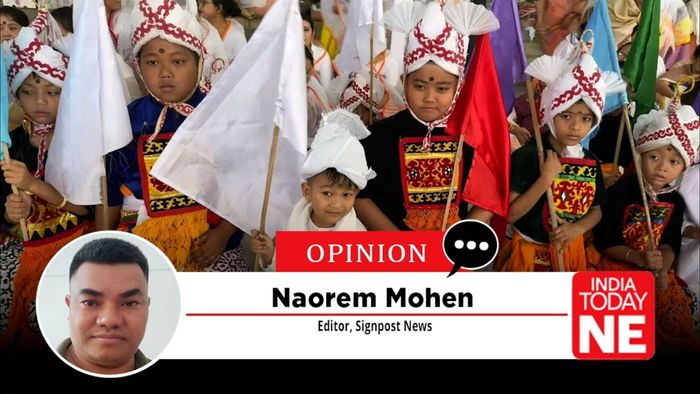
A child watches the elders prepare an offering. Everything has its place. The child knows when to sit quietly, when to follow the elders and when to bow. Then comes a simple question: “Why do we do this?”
Sometimes, an elder answers patiently, recalling what was taught by earlier generations. At other times, the reply is brief: “This is our custom.” The ceremony continues, but the child’s question remains unanswered.
There is something in this ordinary family moment that deserves our attention. We want our children to know their traditions and carry them forward. We worry when they grow up knowing little about their own culture. Yet how often do we sit with them and explain what our parents and grandparents taught us? How much of that responsibility have we left to chance?
Divine Panthou’s teaching reminds us that being Meitei is not simply a matter of worshipping Lainingthou and Lairembi. Our identity must also be reflected in how we live, how we treat others and how we preserve what has been handed down to us.
We may perform our religious duties with sincerity, but what happens after worship is equally important. The language we speak at home, the respect we show our elders and the kindness we extend to a neighbour are all part of the life through which our children come to understand who they are.
Knowing our surname and Salai gives us a connection to our ancestors. We take pride in that inheritance, as we should. But knowing these names is only a beginning. Our children also need to understand the people and the history behind them.
Who were our ancestors? What difficulties did they face? What did they struggle to protect? And what can their lives teach the present generation?
Divine Panthou urges us to remember the stories of our brave Meitei ancestors. But those stories cannot survive through remembrance alone. They must be told, discussed and understood. Someone has to make time to share them, and the younger generation must feel free to listen and ask questions.
Much of what we know about our traditions still lives in the memories of our elders. One may remember how a particular place received its name. Another may know the meaning of an old observance. Someone in the family may understand a prayer that others have repeated for years without knowing what it means.
We often take this knowledge for granted because the people who possess it are still among us. We assume there will always be another day to sit with them and listen.
Then an elder passes away, and we discover that something has gone with them. A familiar custom raises a question, but nobody in the household knows the answer. A story once told around the family is remembered only in fragments. By the time we recognise what has been lost, it may be too late to recover it.
This should make us more patient with young people who know little about their traditions. Before blaming them for their ignorance, we should ask whether we have made any serious effort to teach them. Before complaining that they are no longer interested, we should remember how we responded when they last showed curiosity.
A child who asks why a custom is followed is not necessarily questioning its worth. The child may simply want to understand it. That curiosity deserves an answer, not a rebuke. The same responsibility applies to our language.
Meiteilon carries much more than the words we use in everyday conversation. Through it, children learn how elders express affection, how family members address one another, how humour is shared and how relationships are understood. These things are learnt naturally when a language is spoken regularly at home.
A child listening to a grandparent, joining a family conversation or learning the meaning of an unfamiliar expression is already receiving part of that inheritance.
But children must also be allowed to make mistakes. If every attempt to speak Meiteilon is met with ridicule or impatient correction, they may gradually lose the confidence to use it.
We want our children to learn other languages, acquire an education and find opportunities beyond Manipur. There is nothing wrong with those aspirations. Learning another language need not mean abandoning our own.
We can encourage them to study and work wherever opportunities take them while continuing to speak Meiteilon at home. We can explain words they do not understand, share stories in our mother tongue and give them the confidence to speak it without embarrassment.
A language survives when people use it. Our pride in Meiteilon means little if we ourselves stop speaking it with our children.
Divine Panthou’s teaching goes further. He speaks of the Meitei heart as generous and compassionate. It is a description we would all like to accept with pride. But generosity and compassion are qualities that must be practised if they are to mean anything.
How do we treat an elderly person who tells the same story again and again? How do we respond when someone in the family makes a mistake? Are we willing to help a neighbour who is facing hardship, even when there is nothing for us to gain?
The answers to these questions say much about the values we actually live by. We may observe every detail of a religious ceremony and still speak harshly to members of our own family. We may praise our ancestors and the wisdom of our elders but have little patience when an elderly parent wants to talk. We may teach a child how to prepare an offering while failing to notice how cruelly we sometimes speak to others.
Our children notice these contradictions. They hear what we tell them, but they also watch what we do. If there is a difference between our words and our behaviour, they grow up seeing both.
A child who sees a parent sharing food with someone in need learns something about generosity. A child who watches the family care patiently for an elderly relative begins to understand respect. When children see their elders stand beside a family in difficulty, compassion becomes something familiar rather than merely a virtue spoken of during worship.
Such lessons often remain with them longer than any formal instruction. This is why the responsibility of preserving our traditions cannot be left entirely to religious observances. The values associated with our faith must also find expression in ordinary family life.
Divine Panthou also calls upon those who carry Meitei religious traditions to come forward without fear or hesitation. Their willingness matters, but so does our readiness to listen.
A person who knows an old prayer needs someone willing to learn it. An elder explaining a custom deserves attention. A young person who shows interest in traditional observances should find encouragement rather than indifference.
We cannot expect knowledge to pass from one generation to another unless we create opportunities for that exchange.
Much of this work will take place quietly within our homes. An evening spent listening to an elder may seem unimportant at the time. Explaining the meaning of a prayer to a child may appear to be a small matter. Yet these conversations can help preserve knowledge that might otherwise disappear.
Years later, the child may remember that evening and explain the same tradition to another generation. There is no need for an audience or public recognition. What matters is that the knowledge continues to live.
We must also remember that dignity in our identity is not measured by how loudly we proclaim it. A person can be deeply attached to Meitei traditions without showing disrespect towards others. Indeed, the generosity and compassion that Panthou speaks of should guide our conduct towards people beyond our own community as well.
Love for our own inheritance becomes more meaningful when it teaches us responsibility, patience and consideration for others.
When Divine Panthou speaks of the endurance of the Meitei alongside the endurance of Meitei Leipak, he draws our attention to the relationship between a people and their homeland.
Meitei Leipak is not merely a place we name with affection. It is where generations have lived, worshipped, spoken their language and passed on their memories. Our ancestral places, religious traditions, family histories and everyday relationships are all connected to it.
But these connections cannot be sustained by pride alone. They need people who know their meaning and are willing to preserve them.
Every generation inherits something from those who came before it. What it passes on depends on how carefully that inheritance is understood and lived.
We cannot recover every forgotten story or every custom that has disappeared. But there is still much we can do with what remains in our families and communities.
We can spend time with an elder while there is still an opportunity to listen. We can learn the meaning of a prayer instead of repeating it without understanding. We can speak Meiteilon with our children, answer their questions patiently and make sure that the kindness we teach them is also visible in our own behaviour.
These may appear to be small acts. Yet they are within our reach, and they give the next generation something more enduring than instructions about what it means to be Meitei. They give our children an example to follow.
One day, the child who watched the elders preparing an offering may be preparing it for the next generation. Another young voice may ask the same question: “Why do we do this?”
Whether that child receives a meaningful answer will depend, in no small measure, on what we choose to teach and practise today.
(The views expressed in this article are those of the author and do not necessarily reflect the views of India Today NE or its affiliates)