What Happened to the May 2022 Pledge by 50 Kuki Chiefs in Kangpokpi to Ban Poppy Plantation?
In May 2022, a delegation of village chiefs from Saikul Assembly Constituency (under Kangpokpi district), led by MLA Kimneo Haokip Hangshing, submitted a resolution to Manipur Chief Minister N. Biren Singh. The chiefs, representing around 50 villages, expressed strong support for the state government's "War on Drugs" campaign.
- Dec 27, 2025,
- Updated Dec 27, 2025, 2:25 PM IST
In May 2022, a delegation of village chiefs from Saikul Assembly Constituency (under Kangpokpi district), led by MLA Kimneo Haokip Hangshing, submitted a resolution to Manipur Chief Minister N. Biren Singh. The chiefs, representing around 50 villages, expressed strong support for the state government's "War on Drugs" campaign.
The signed resolution stated that, after extensive deliberations on the harms of poppy cultivation, they had resolved to immediately halt all poppy plantation in the Saikul area. They also urged the Government of Manipur to provide alternative livelihood options for affected farmers. Additionally, it warned that any individuals or groups defying the resolution would face legal consequences at their own risk.
Speaking to the media, Chief Minister N. Biren Singh praised the initiative, noting that multiple communities were rallying behind the campaign due to poppy cultivation's severe environmental damage and threats to future generations. He highlighted the Saikul chiefs as the first from the Kuki community to publicly take such a bold stand against poppy plantation.
However, in the years following this pledge—particularly after the ethnic violence that erupted in May 2023—poppy cultivation persisted in parts of Kangpokpi district, with thousands of acres destroyed by authorities amid ongoing tensions.
According to official data presented in Parliament, Kangpokpi district recorded the highest area under illegal opium poppy cultivation in Manipur during 2023-24, with 17.49 square kilometres (approximately 4,322 acres).This was revealed by Union Minister for Environment, Forest and Climate Change Bhupender Yadav in a written reply to questions posed by Inner Manipur Congress MP Prof. Angomcha Bimol Akoijam in the Lok Sabha on December 16, 2024.
The statewide total for illegal poppy cultivation in 2023-24 stood at 45.68 square kilometres (about 11,288 acres).Breakdown by forest classification showed the majority in unclassed forests at 20.40 sq km (5,041 acres), followed by protected forests at 19.24 sq km (4,754 acres), reserved forests at 3.47 sq km (857 acres), proposed reserved forests at 2.51 sq km (620 acres), and a small portion in protected wildlife areas at 0.06 sq km (14 acres).
These figures highlight Kangpokpi District's persistent prominence in the issue, even as overall cultivation declined from previous years amid intensified enforcement and ethnic tensions.
For the second time, in December 2025, Kuki civil society organisations and Kuki village chiefs in Kangpokpi district have unanimously resolved to impose a complete ban on poppy cultivation starting January 1, 2026. Announced on December 23, 2025, after a series of consultations involving the Sadar Hills Chiefs’ Association, Kuki Inpi Sadar Hills, tribal bodies, student groups, women's organisations, and youth clubs, the declaration cites the devastating social, environmental, economic, and moral impacts of poppy farming. Violators, including village chiefs, face strict penalties.
On paper, this is a historic and commendable step, reflecting what the groups call the "collective will of the people."Yet, forgive the skepticism—this sounds all too familiar. This also raises questions about the implementation of the 2022 resolution and the broader challenges in eradicating illegal poppy farming in the region.
While national media have covered the new move by Kuki chiefs and CSO as "historic," skepticism lingers in light of past unfulfilled pledges.
The joint declaration emphasises the profound social, environmental, economic, and moral damage inflicted by poppy farming, framing the ban as a resolute expression of the community's collective will—with strict penalties promised even for village chiefs who fail to comply.
The sudden emphasis on environmental concerns inevitably raises eyebrows. For years, extensive poppy cultivation in Manipur's hill districts, including Kangpokpi, has been linked to the clearing of thousands of acres of reserved and protected forests, contributing to deforestation, soil erosion, and heightened flood risks in the Imphal Valley.
Critics have long accused cultivators of prioritising short-term gains over ecological sustainability. So why this newfound vocal commitment to environmental protection?
Is it a genuine awakening—born from witnessing the irreversible degradation of their own lands, rivers, and forests—or a calculated public relations effort to reposition the community as stewards of the environment amid ongoing ethnic tensions and external scrutiny?
The timing, coming after years of persistent cultivation despite earlier pledges, invites such questions. Only sustained action on the ground, particularly through the 2026 planting season, will reveal whether this resolve reflects heartfelt fatigue with the destruction caused by poppy farming or a strategic bid to reshape narratives in a deeply polarised conflict. Whether this renewed commitment finally translates into action or fades like its predecessors will be seen soon.
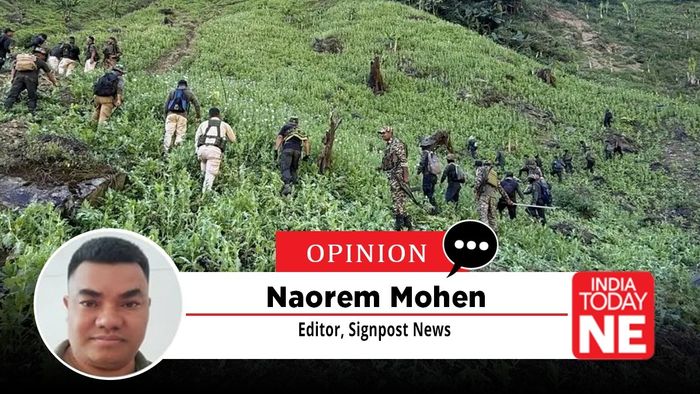
Just days before the December 2025 district-wide ban was announced, security forces intensified their crackdown on poppy cultivation in Kangpokpi. Between December 5 and 6, they destroyed around 67 acres across the hill ranges of Makui Ashang, Laloi, Wakotphai, and Chaljang.
A few days earlier, on December 1, another 54 acres were razed in the areas between Khoiripok-Sehjang and C. Lamjang.Going back to November, similar operations had cleared additional fields: 56 acres near Thonglang Akutpa and Songjang, and 25 acres in Awlmun and Loibol Khullen villages.
A multi-phase drive from December 16-20 razed over 600 acres statewide, including 559 acres in Ukhrul and 42 acres in Kangpokpi's L. Simol, Jangnomphai, and SP Ngaimun—where 20 huts, fertilizers, herbicides, and poppy seeds were also seized. November alone saw over 675 acres destroyed, despite an aerial survey on November 24 detecting more than 700 acres in Kangpokpi.
Earlier, last month, in a multi-day operations from November 11-15 cleared 486-527 acres across Kangpokpi, Ukhrul, and Senapati, with specific drives like 113 acres in Ukhrul (including Lamlai Chingphei) on November 14, 35 acres in Mullam on November 13, and 25 acres in Awlmun on November 12.
On January 31, 2025, a mob of around 80 armed with sticks attacked police and CRPF destroying fields in Lhungjang village (Saikul area, Kangpokpi)—native to Kuki Inpi Manipur president Ch. Ajang Khongsai. Vehicles were damaged; reinforcements quelled the situation. The government condemned the violence, filed an FIR at Saikul station, and vowed action against all, including Khongsai due to his links.
However, a striking example of community-driven action came from Ukhrul district in late 2025. On November 5, volunteers from the Committee Against Poppy Plantation (CAPP), based in the Zalenbung area and led by Convenor S. Hesat Haokip and Secretary Th. Baite, took matters into their own hands. Just ahead of the harvest season, they destroyed stockpiles of manure, urea, salt, and other fertilizers meant for poppy farming in villages like Shongphel (also known as Songphel), Mullam, and Lamlai Chingphei.
A video of the volunteers burning these materials went viral, drawing widespread praise online as a rare display of genuine grassroots commitment to fighting the drug menace.Security forces quickly followed up.
In November and December alone, joint operations razed hundreds of acres across the district—starting with smaller drives like 35 acres in Mullam on November 13 and 113 acres across sites including Lamlai Chingphei the next day, then escalating to massive clearances of 436–559 acres in mid-to-late December. Huts used by cultivators were burned, and FIRs filed against those involved.
These proactive steps in Ukhrul, a Tangkhul majority area, stand in sharp contrast to the challenges faced in Kuki-dominated districts, where similar pledges have often struggled to take root amid the ethnic tensions that flared up before May 2023.
For instance, in June 2023, Kuki National Organisation (KNO) president PS Haokip issued a 10-day ultimatum urging growers to voluntarily destroy their fields. He reiterated a longstanding 2016 ban within the community, blamed persistent cultivation on outsiders not bound by Suspension of Operations Agreements, and warned that continued involvement was bringing disgrace through arrests.
Going further back, in 2022, the Kuki Chiefs’ Association in Tengnoupal district held a meeting at Tuinom Village Hall. Following the Chief Minister's guidance, they reaffirmed their ban on poppy planting, set up a 10-member monitoring committee, and appealed for government help with alternative livelihoods. Vice President Th. Thokhothang Haokip stressed the need for full compliance to support the state's campaign.
Yet, despite these repeated commitments, large-scale poppy fields continued to appear in several hill districts, highlighting the deeper hurdles—economic pressures on poor farmers, enforcement gaps, and lingering distrust—that make turning words into lasting change so difficult.
The earlier pledge by 50 Kuki village chiefs of Saikul to halt poppy cultivation marked a hopeful step in supporting Manipur's "War on Drugs," but subsequent years saw persistent plantations in Kangpokpi district, with thousands of acres destroyed amid ethnic tensions and enforcement challenges.
Now, with the December 2025 district-wide ban announced by Kuki civil society organisations—effective January 1, 2026, and backed by unanimous consultations involving chiefs and community groups—there is renewed optimism that commitments will translate into lasting action.
For success, broad support from all stakeholders is essential, including strict enforcement against violations and urgent government provision of viable alternative livelihoods for affected farmers.
However, concerns linger: anonymous reports from locals in areas like Saikul suggest that shortly after similar announcements, black market prices for opium gum ("kani") have surged—from around Rs 80,000 to Rs 1.5–2 lakh per kg—potentially enriching traffickers while poor farmers bear the economic brunt.
Some farmers also view such bans skeptically, fearing they shield influential figures without adequate penalties or sustainable crop replacements.
Ultimately, actions will speak louder than announcements. All stakeholders—CSOs, chiefs, security forces, and government—must be held accountable. A poppy-free Manipur isn't just about narcotics; it's about reclaiming forests, livelihoods, and trust.
Let's watch the 2026 season closely, hoping this time, words become enduring reality.