What Sankardeva Still Teaches Us
He was a poet, dramatist, musician, painter, institution-builder and social reformer who understood that a society could be transformed not merely through doctrine, but through culture.
- Sep 21, 2026,
- Updated Sep 21, 2026, 1:28 PM IST
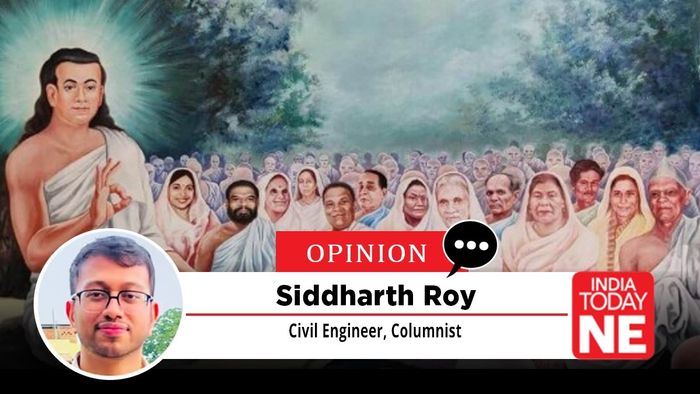
Every September, Assam pauses to remember a man who lived in the 15th and 16th centuries but whose ideas continue to shape its cultural imagination. On September 21, the Janmotsav of Srimanta Sankardeva is observed across the State. Yet Sankardeva deserves to be remembered as more than the founder of a religious movement. He was a poet, dramatist, musician, painter, institution-builder and social reformer who understood that a society could be transformed not merely through doctrine, but through culture.
Born in 1449 at Bordowa in present-day Nagaon, Sankardeva emerged in a medieval Assam marked by social divisions and competing religious practices. His answer was Ekasarana Namadharma, a devotional tradition centred on surrender to one God and expressed through collective prayer, music, literature and community. At Bordowa, he established a Kirtan Ghar and developed the institutional form of the Namghar, a space that became simultaneously a place of worship, cultural expression and community life. The Assam government describes the Namghar and Monikut as among his distinctive contributions to Assamese society.
His achievement was remarkable because he did not confine spiritual teaching to scriptures or sermons. He translated philosophy into forms ordinary people could encounter. His Borgeet gave devotion a musical language. His Ankiya Naat and Bhaona turned theology into theatre. His paintings and the traditions associated with Sattriya dance expanded the vocabulary of Assamese art. The satra became an institution through which religious practice, education, artistic expression and social organisation could reinforce one another. The result was not simply a religious community, but a civilisational framework.
This is why Sankardeva's relevance today extends far beyond questions of faith. His most important lesson may be that culture can be a force for social cohesion. At a time when societies everywhere are becoming more fragmented by identity, ideology and digital echo chambers, Sankardeva's emphasis on collective participation offers a different possibility. The Namghar was not designed as a private retreat from society. It was a shared space. Its enduring presence in Assamese villages reminds us that community is not created by slogans; it is created by institutions where people meet, listen and participate.
There is another lesson in his extraordinary use of the arts. Sankardeva understood something that modern public life often forgets: people do not always absorb ideas through arguments. They remember stories, songs, images and performances. His religious philosophy travelled because it was carried by poetry, music, theatre and visual culture. In an age of short attention spans and algorithm-driven communication, this insight is particularly valuable. Public education, social reform and even civic values become more durable when they are communicated through culture rather than instruction alone.
Sankardeva's life also challenges the tendency to equate tradition with stagnation. He drew upon India's older philosophical traditions but created new institutional and artistic forms suited to his society. Tradition, in his example, was not a museum object. It was something that could be renewed. This is an important lesson for contemporary Assam and India: preserving heritage should not mean freezing it in time. A living tradition survives by remaining meaningful to successive generations.
His vision also carried a strong ethic of human fellowship. The Srimanta Sankaradeva Kalakshetra, named after him, describes his legacy in terms of unity in diversity and universal brotherhood. That interpretation is significant because Sankardeva's cultural world was not constructed by erasing difference. His movement absorbed local cultural elements and created institutions that could connect communities through shared practices. His legacy therefore offers an alternative to both cultural isolation and homogenisation.
The lesson is particularly relevant to Assam, a State whose strength lies in its extraordinary diversity. Tribal communities, linguistic groups and different cultural traditions have contributed to the making of Assamese society. Sankardeva's legacy should not be invoked to flatten that diversity. It should instead remind us that a shared cultural identity becomes stronger when it has room for plurality.
Remembering Sankardeva, therefore, should involve more than annual rituals and ceremonial speeches. His works deserve rigorous scholarship, translation and wider teaching. Children should encounter him not only as a saint but as a creator who connected literature, music, theatre, art and social reform. His manuscripts, performing traditions and institutional heritage require preservation, while younger generations need opportunities to reinterpret them creatively.
The true measure of Sankardeva's legacy is not how loudly we celebrate his birth anniversary, but how thoughtfully we carry forward his ideas. His life suggests that spirituality can coexist with creativity, tradition with renewal, and cultural identity with openness. In an age searching for ways to rebuild trust and community, that may be his most enduring gift.
On his Janmotsav, Assam should not merely remember Sankardeva, but ask what kind of society his vision invites us to build. The answer is to carry forward his spirit of creativity, fellowship and cultural confidence into the future together.