When Influence Becomes Relief: Assam’s Floods and the New Power of Digital Solidarity
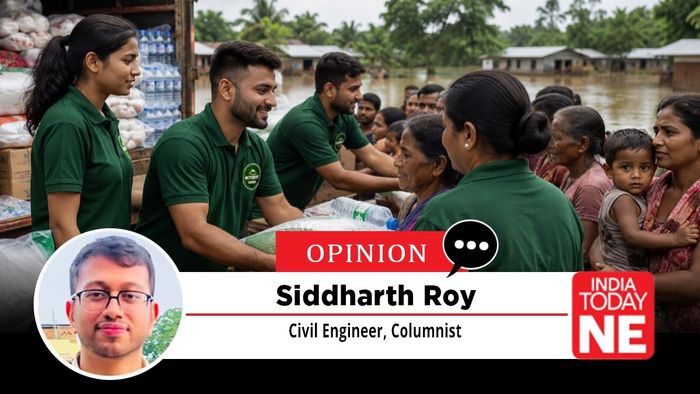
When Assam floods, the first images usually come from the ground: submerged homes, stranded families, exhausted rescuers and animals searching for higher ground. In 2026, however, another set of images travelled rapidly across India — those shared by celebrities, YouTubers, musicians and social-media creators who used their enormous digital audiences to draw attention to Assam's suffering and mobilise assistance.
- Aug 10, 2026,
- Updated Aug 10, 2026, 3:00 PM IST
When Assam floods, the first images usually come from the ground: submerged homes, stranded families, exhausted rescuers and animals searching for higher ground. In 2026, however, another set of images travelled rapidly across India — those shared by celebrities, YouTubers, musicians and social-media creators who used their enormous digital audiences to draw attention to Assam's suffering and mobilise assistance.
This development deserves attention not because influencers can replace governments or professional disaster-response agencies, but because they can perform something that conventional relief systems often struggle to do quickly: convert attention into collective action.
The 2026 floods have once again demonstrated the scale and persistence of Assam's vulnerability. Thousands of villages have faced inundation, livelihoods have been disrupted and large numbers of people have required evacuation and relief. At such a moment, public attention itself becomes a resource. If used responsibly, the reach of digital creators can help transform distant sympathy into food, medicines, donations and other forms of assistance.
One of the most striking examples this year has been YouTuber Nischay Malhan, popularly known as Triggered Insaan. His 50-hour livestream for Assam flood relief reportedly mobilised about ₹70 lakh, combining public contributions with support from the Malhan family. The exercise demonstrated the extraordinary fundraising potential of creator communities: a digital audience that normally gathers for entertainment could, within hours, become a philanthropic network.
Another prominent example is YouTuber CarryMinati (Ajey Nagar), who raised ₹13 lakh through a charity livestream for flood relief in 2026. His intervention is particularly noteworthy because it builds on an earlier pattern of using his online audience during disasters. In 2022, he had also used a livestream to raise funds for Assam flood relief.
The significance of these initiatives lies less in the personalities involved than in the mechanism they reveal. An influencer possesses something traditional relief campaigns often lack: immediate access to a large, emotionally connected audience. A single video, livestream or social-media post can reach millions, explain the urgency of a crisis and provide a pathway for people to contribute.
The same principle was visible in the response of actor Bhumi Pednekar, who used Instagram to draw attention to the Assam floods and urge her followers to contribute. Singer Papon, who is from Assam, also appealed through social media for assistance to flood victims. Actor Adah Sharma shared information and contact details relating to relief efforts, while several other public personalities amplified calls for support.
Actor Salman Khan, through his Being Human initiative, went beyond a social-media appeal by launching a phased relief campaign involving food, medicines and essential supplies. This illustrates an important distinction: influence becomes more valuable when visibility is connected to an organised mechanism for delivering assistance.
The humanitarian value of such interventions can be understood in three ways.
First, they close the information gap. Assam's floods are recurrent, and their repetition can paradoxically reduce national attention. Influencers can break through this fatigue by presenting the crisis to audiences that may otherwise encounter it only briefly in mainstream news coverage.
Second, they democratise giving. A person who cannot travel to Assam or organise a truckload of supplies can contribute a modest amount through a verified fundraising channel. When thousands of followers make small contributions, their aggregate impact can become substantial.
Third, influencers can connect fragmented networks. Their audiences include people across cities, professions and economic backgrounds. During a disaster, this network can rapidly connect donors with credible relief organisations and local initiatives.
Research on disaster communication increasingly recognises the importance of social-media influencers in disseminating emergency information. A 2026 study published in Scientific Reports noted that influencers can function as central nodes for rapidly spreading crisis information to communities.
But influence also carries responsibility.
The first requirement must be verification. Disaster situations create fertile ground for misinformation, fraudulent donation appeals and exaggerated claims. Influencers should therefore promote only verified organisations, official relief funds or transparent local initiatives. They should disclose how money will be transferred and, wherever possible, publish subsequent accounts of its utilisation.
The second requirement is coordination. Relief cannot be reduced to visibility. Flood victims may need boats and rescue assistance at one moment, drinking water and medicines the next, and livelihood support weeks later. Influencers should coordinate with district administrations, recognised humanitarian organisations and local volunteers rather than independently distributing resources without understanding actual needs.
The third is dignity. Disaster victims should not become content. Images of grieving families and devastated homes may attract attention, but humanitarian communication must not turn suffering into spectacle. The objective should be to mobilise assistance, not maximise engagement.
There is also a larger question that should not be avoided. Why should citizens repeatedly have to mobilise extraordinary digital campaigns for a disaster that Assam experiences almost every year? Influencer-led relief is valuable, but it cannot substitute for resilient infrastructure, floodplain management, early-warning systems, embankment maintenance, disaster preparedness and long-term rehabilitation.
Nor should celebrity visibility overshadow the thousands of ordinary Assamese citizens, volunteers, community groups and local organisations who work quietly during every flood. The greatest humanitarian response is often organised far from the camera.
Yet the emergence of influencers as crisis-time mobilisers should not be dismissed as mere publicity. It represents a new form of civic capacity. Digital platforms have created networks that can be activated within minutes, and those networks can save lives and livelihoods when connected to credible institutions.
The lesson from Assam's 2026 floods is therefore not that influencers should become disaster managers. It is that their reach can become a powerful public asset when combined with professional relief systems, local knowledge and transparent accountability.
The challenge now is to institutionalise this potential. Governments and credible relief organisations could maintain verified digital partnerships with responsible creators, establish protocols for emergency information, provide authenticated donation channels and create mechanisms for tracking relief contributions.
In a flood-prone State where attention often recedes long before the water does, the ability to keep Assam visible matters.
Influence is usually measured in followers, views and engagement. During a disaster, however, it should be measured differently — by how effectively an audience can be transformed into solidarity, and solidarity into help.
That may be the most meaningful use of influence in an age of recurrent crises.