When Volunteers Carry the Burden of the State: Manipur's Forgotten Families
RSS Manipur Prant and service organisations gave financial aid and offered Class XII education to families of three Nongshum victims. The intervention highlights demands for sustained government rehabilitation beyond one-time compensation.
- Oct 28, 2026,
- Updated Oct 28, 2026, 2:50 PM IST
Three men went out to collect firewood. They never returned home alive. For the families of Arubam Ronil Meitei, Lairenlakpam Inaobi Singh and Kshetrimayum Sushil Singh, the killings at Nongshum in Imphal East were not merely another incident in Manipur's continuing conflict. Three families lost their loved ones. For those who depended on the deceased, the tragedy also brought uncertainty about how they would survive in the months and years ahead.
The killings, allegedly carried out by Kuki militants, have once again brought attention to the insecurity that continues to affect ordinary people in Manipur. But there is another question that deserves equal attention. What happens to the families after the funeral, after the public protests and after the condemnations have disappeared from the headlines?
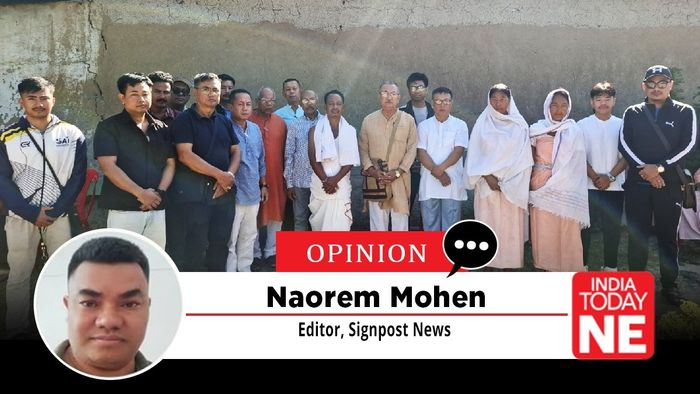
On Sunday, a 30-member team comprising karyakartas of the Rashtriya Swayamsevak Sangh (RSS) Manipur Prant, Seva Samiti Manipur and Seva Bharati Manipur visited Nongshum to extend humanitarian assistance to the bereaved families.
Led by RSS Manipur Prant Karyawah Shijagurumayum Tarunkumar Sharma and Senior Pracharak Laishram Jatra Singh, the team handed over financial assistance to the next of kin of the three victims. They also offered free educational facilities up to Class XII for members of the affected families, subject to their acceptance.
The financial assistance will help the families meet some immediate needs. But the offer of education is particularly significant. It recognises that the consequences of violence do not end when the dead are cremated or buried.
A child who loses a father may also lose the opportunity to complete an education. A widow may suddenly find herself responsible for feeding and educating her children without a regular income. Elderly parents may lose the person on whom they depended for their daily needs.
A few thousand rupees, or even a substantial one-time compensation payment, cannot address all these difficulties.
What the RSS and its service organisations have offered at Nongshum is therefore worth examining beyond the immediate act of charity. Their intervention raises a larger question about the responsibility of the government towards families whose lives have been permanently altered by the conflict.
The humanitarian activities of RSS Manipur Prant, Seva Bharati Manipur and Seva Samiti Manipur did not begin with the Nongshum killings.
According to the organisations, they have been extending financial assistance to families of people killed during the violence since May 3, 2023. Their activities have also included free residential education for more than 150 internally displaced students in schools within and outside Manipur.
Educational kits, school uniforms and coaching classes have been provided to displaced students living in relief camps. Essential commodities and medical camps have formed part of their continuing humanitarian work.
The reported educational assistance is particularly important. When families are displaced, children's education is often among the first casualties. Parents who have lost their homes and livelihoods cannot always afford school fees, uniforms, textbooks or accommodation. Some children are forced to change schools repeatedly. Others risk dropping out altogether.
Providing residential education to displaced students is an attempt to protect their future from the consequences of a conflict they did not create.
One may agree or disagree with the ideology of the RSS. Political and ideological differences are natural in a democratic society. But humanitarian work should be recognised on its own merits.
A child receiving education does not benefit less because the assistance comes from an organisation with which someone has political disagreements. A family struggling to survive cannot afford to turn every act of compassion into an ideological argument.
The more important questions are whether the assistance reaches those who need it, whether it is provided fairly and whether it makes a lasting difference. These are the standards by which humanitarian service should be judged.
Since May 2023, much of the discussion surrounding the conflict has centred on killings, displacement, political demands, security failures and the search for a settlement. These issues are undeniably important. But behind them are thousands of ordinary people trying to rebuild lives that were suddenly disrupted.
Some families have lost their principal earning members. Others have been separated from their homes and traditional occupations. Children have spent years away from familiar surroundings, while elderly people have been forced to depend on relatives, relief camps or charitable assistance.
Voluntary organisations have stepped into many of these situations. Their work may involve providing food or clothing, arranging medical treatment, supporting children's education or helping a family overcome an immediate financial crisis.
Such assistance does not always attract publicity. Nor does every organisation have the resources to undertake large rehabilitation programmes. Yet the importance of their contributions should not be underestimated.
There are families for whom a school admission, a medical intervention or a timely financial contribution can make the difference between recovering from a tragedy and falling into deeper hardship.
Every casualty leaves behind a human story. Every displaced household carries a different burden. Every child whose education has been interrupted represents a future that requires protection.
These organisations have recognised at least part of that responsibility. The government must recognise it on a much larger scale.
The Manipur government has undertaken relief and rehabilitation measures for conflict-affected people. Financial assistance, relief camps, support for internally displaced persons and resettlement initiatives have been part of the official response.
These efforts are necessary and should be acknowledged. However, the question is whether they are sufficient to address the long-term consequences of the violence.
There is a fundamental difference between compensating a family for the death of an earning member and ensuring that the surviving family can rebuild its life. Compensation provides immediate financial relief. Rehabilitation requires sustained attention.
A government may announce an ex gratia payment after a killing. Officials may visit the bereaved family. Political leaders may express condolences and promise assistance. But what happens six months later?
Who checks whether the children are still attending school? Who ensures that the surviving spouse has a sustainable source of income? Who looks after elderly parents who have lost their only support?
And who takes responsibility when a family exhausts its compensation money and begins to struggle again? These are not minor administrative questions. They go to the heart of what a welfare government is expected to do.
Manipur's conflict has created circumstances in which conventional relief measures alone cannot adequately address the needs of affected families.
The government needs to demonstrate that its rehabilitation policies extend beyond compensation payments and temporary assistance.
The fact that voluntary organisations are offering long-term educational support should encourage the government to examine whether similar guarantees are available to every eligible family that has lost an earning member.
If such schemes already exist, the administration should make their coverage, eligibility and implementation publicly accessible. If gaps remain, they must be addressed.
The purpose should not be to compete with voluntary organisations. It should be to ensure that no family is left dependent entirely on charity.
Consider the educational offer made to the families of the Nongshum victims. The RSS and its service organisations have offered support up to Class XII. This is a meaningful commitment because it looks beyond the immediate financial consequences of the killings.
But why should such educational security depend on whether a particular family receives help from a voluntary organisation?
What about other families who have lost their earning members but have not received similar offers? What about children whose parents were killed in incidents that attracted little media attention?
What about those living in remote villages where humanitarian organisations may not be able to reach regularly?
The government has a responsibility to ensure that assistance is not determined by publicity, political connections, geographical accessibility or the goodwill of individual organisations.
Every eligible child who has lost a parent or principal caregiver because of the conflict should have access to assured educational support. That support should not necessarily end with Class XII. Children who wish to pursue higher education, technical training or professional courses should also have opportunities to continue.
The same principle should apply to surviving spouses and elderly dependants. Widows who have lost their husbands should be able to access appropriate livelihood programmes, vocational training and financial assistance. Elderly parents who have lost their earning children may require continuing medical and income support.
These are not extraordinary demands. They are practical measures that can prevent one violent death from pushing an entire family into long-term poverty.
The government possesses administrative machinery, public funds and institutional resources that voluntary organisations cannot match.
It should use those resources to establish a comprehensive support system for conflict-affected families. One of the weaknesses of conventional rehabilitation is the tendency to treat affected people as numbers.
Officials count the dead, the displaced, the houses damaged, the compensation claims processed and the families resettled. These figures are necessary for administration. But they do not tell the complete story. Two families receiving the same compensation may have entirely different needs.
One may have several earning members and sufficient resources to recover. Another may consist of a widow, three school-going children and elderly parents with no independent income.
Treating both families identically may satisfy an administrative requirement without producing an equitable outcome. A more effective rehabilitation policy would begin by assessing the circumstances of each affected household.
The government should identify families that have lost their principal earning members and evaluate their educational, medical, housing and livelihood requirements. Support should then be designed according to those needs.
For displaced families, rehabilitation must also include the restoration of livelihoods and safe access to their homes wherever conditions permit. One of the most disturbing consequences of prolonged conflict is the gradual normalisation of suffering.
A killing becomes a headline. Condemnations follow. Organisations organise protests. Political leaders issue statements. Then another incident occurs, and public attention shifts elsewhere.
But the bereaved families cannot move on so easily. The children still have to attend school. Food must still be placed on the table. Medical expenses must still be paid. The household must somehow continue without the person who once held it together.
For them, the tragedy is not yesterday's news. It becomes part of everyday life. This is why the humanitarian assistance extended at Nongshum deserves attention.
The financial support provided by RSS Manipur Prant, Seva Samiti Manipur and Seva Bharati Manipur is important. Their offer of education up to Class XII is particularly noteworthy because it recognises the future needs of the bereaved families. These initiatives demonstrate that Manipur still has people willing to stand beside those who are suffering.
But appreciation for voluntary service must not become an excuse for lowering expectations of the government. Indeed, the opposite should happen.
When an organisation with limited resources can recognise the need to educate the children of conflict victims, the government should be able to develop a broader institutional mechanism to provide comparable security to all eligible families.
When volunteers can identify vulnerable households and offer assistance, the administration should be able to establish a reliable system for monitoring their long-term rehabilitation.
And when civil society continues to support victims years after the conflict began, the state must demonstrate that its responsibility does not end with the release of compensation.
The three men killed at Nongshum cannot be brought back. No amount of financial assistance can undo the loss suffered by their families. But there is still much that society and the government can do for those they have left behind.
Their children can be educated. Their dependants can be supported. Their families can be helped to regain financial stability and dignity. That would be a more meaningful tribute than another round of speeches and condolences.
Manipur should be grateful to the volunteers and humanitarian organisations that continue to serve its suffering people. Their efforts deserve recognition and encouragement.
At the same time, the government must accept that the future of conflict-affected families cannot be left to voluntary organisations alone.
A government must do more than compensate the dead. It must protect the living, rebuild broken families and ensure that the next generation does not inherit the poverty and insecurity created by today's violence.
(The views expressed in this article are those of the author and do not necessarily reflect the views of India Today NE or its affiliates)