Where Were the Kuki Militants When SoO Camps Were Empty?
Evidence from joint physical inspections in 2023 clearly indicates widespread absenteeism among SoO cadres from their designated camps, strongly suggesting that many of these absent militants were involved in attacks on innocent Meitei civilians and security personnel during the ethnic clashes that erupted on May 3, 2023.
- Jan 13, 2026,
- Updated Jan 13, 2026, 7:07 PM IST
Evidence from joint physical inspections in 2023 clearly indicates widespread absenteeism among SoO cadres from their designated camps, strongly suggesting that many of these absent militants were involved in attacks on innocent Meitei civilians and security personnel during the ethnic clashes that erupted on May 3, 2023.
A Joint physical inspections in 2023 revealed widespread absenteeism. For instance, at Nalon Camp (S Nabil) in Churachandpur, the ZRF/KNO faction (30 registered cadres) recorded dismal attendance: March (3), April (4), May (9), June (4), July (4), August (4), September (1), October (3), November (3), December (3)—often below 10–20%, with September at just 3.3%.
The larger KNF(MC)/KNO group (65 cadres) fared somewhat better but still inconsistently, hovering around 40–60% in many months.Similar low compliance appeared in other camps like Mongbung (Salem) and T Gamnom (Kangpokpi), with overall attendance across KNO (≈1,122 cadres) and UPF (≈1,059) frequently below 50% during critical periods.
Despite these clear violations—breaches of confinement, weapon security, and non-hostility clauses—the response from authorities was conspicuously muted.
The Ministry of Home Affairs (MHA), which holds primary oversight of the tripartite pact, did not immediately impose penalties, suspend stipends, or move toward abrogation.
The chronic absenteeism of Kuki militant cadres from their designated Suspension of Operations (SoO) camps during the height of ethnic violence in 2023—coupled with the evident failure of central and state authorities to enforce the agreement's core provisions—played a direct role in the outbreak and escalation of the May 2023 clashes.
This pattern set the stage for its disturbing repetition, as seen in the January 2026 incident at Ireng Naga Village (also known as Puilong) in Kangpokpi district.By breaching fundamental SoO ground rules—strict camp confinement, secure weapon custody, suspension of hostilities, and no intimidation or offensive actions—absentee cadres created a dangerous vacuum in the state.
This enabled unrestricted movement, potential re-arming, and involvement in violence that claimed over 300 lives and displaced tens of thousands from 2023-2024.
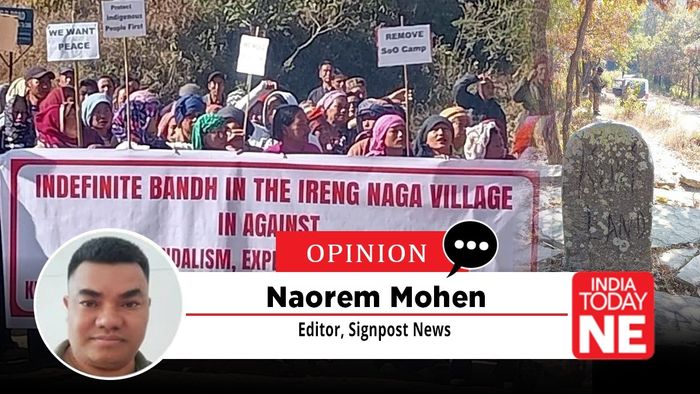
Nearly three years on, the events of January 11–12, 2026, in Ireng Naga Village reveal the same flaws persist. Armed cadres from the KNF(P)/UPF—bound by the revised SoO ground rules of September 2025—allegedly entered the unarmed Naga village in combat gear.
They vandalized public property, including a waiting shed, entry gate, and other materials, and defaced the memorial stone with provocative slogans such as “Kukiland” and “Stay Away.”
The situation escalated further on January 12 when a leader (allegedly Tiger Kipgen, alias Thangboi Kipgen or Haogenthang Kipgen) issued explicit threats via WhatsApp and phone calls to open fire and burn the entire village.
Subsequently, 30–40 heavily armed cadres advanced toward the village in full combat gear—all in broad daylight and in plain view of security forces under President's Rule.
How else to explain armed Kuki militants under SoO pact openly threatening Naga village chiefs, mobilizing in groups of 30 with weapons, and asserting "Kukiland" territorial claims right under security forces' noses? This isn't oversight; it's a systemic failure that allows militants to intimidate civilians, issue death threats, and parade arms without consequence—echoing the May 3 mobilization that devastated Manipur.
No immediate intervention, disarmament, or arrests occurred, echoing the passive response to initial mobilizations in Torbung and Churachandpur on May 3, 2023.
This recurring pattern—SoO-affiliated militants absent or loosely monitored, roaming freely with weapons, intimidating civilians, asserting territorial claims, and threatening villages without consequence—exposes the failure of both the original and revised ground rules.
If the SoO (Suspension of Operations) cadres had been properly checked, disarmed, and confined to their designated camps starting from May 3, 2023, the ethnic clashes could have been prevented. There would have been no opportunity for armed Kuki militants to launch attacks on Meitei communities in places like Churachandpur, Torbung, Phougakchao Ikhai, Moreh, Dolaithabi, Ikou, Kangpokpi, and other areas.
However, if these same cadres are released again and allowed to operate freely—as appears to have happened in the recent incidents at Ireng Naga village on January 11 and 12, 2026—who will bear the responsibility for the resulting escalation, threats, vandalism, and potential further violence?
The Manipur government, under Chief Minister N. Biren Singh, withdrew from the SoO in March 2024, citing "serious ground rules violations" and arguing the pact created a "conflict of interest" by including the groups in their own monitoring. Yet the Centre continued dialogues and maintained a "status quo" on the ground, allowing operations to persist informally.
Pre-2025, UPF operated seven camps (three in Kangpokpi, one each in Chandel and Churachandpur, two in Pherzawl), while KNO ran seven (four in Churachandpur, two in Kangpokpi, one in Tengnoupal), totaling about 14 camps.
The recent vandalism and threats in Ireng Naga starkly contradict SoO requirements: confinement to camps, double-locked weapon storage, restricted movement (no more than 20% outside at once), and bans on violence, extortion, intimidation, and public arms display.
The apparent inaction by CRPF and Manipur police as spectators only heightens concerns over monitoring lapses by the Joint Monitoring Group and the erosion of SoO credibility amid ongoing tensions.
Camp reductions and relocations (from 14 to 12, with seven shifted from conflict-prone, populated, highway-adjacent, or vulnerable areas) aimed to eliminate staging grounds for incursions—yet the incident occurred near populated Naga zones, highlighting persistent gaps.
The Working Committee, Liangmai Naga Council, Manipur, rightly condemned these acts as "terror-inducing" and systematic violations, demanding FIRs, an NIA probe, disarmament, arrests, and SoO revocation. Such calls highlight the urgent need for decisive action.
The political pathway clause—committing to time-bound tripartite dialogue for a negotiated settlement under the Constitution while reaffirming Manipur's integrity—rings hollow when SoO groups provoke communal disharmony and undermine that integrity.
Persistent failure to enforce confinement and other rules has trapped Manipur in a cycle of impunity, undermining public safety, ethnic harmony, and the rule of law.
The Ireng Naga incident marks a particularly alarming post-2025 milestone: the first overt, large-scale breach where SoO-bound cadres openly vandalized, issued death threats, and mobilized armed men against unarmed residents—without decisive response.
This echoes the unchecked mobilizations of May 3, 2023, where SoO-affiliated elements displayed arms freely while security forces remained passive.
Repeated tolerance of such actions under SoO cover—despite documented absenteeism and violations—raises unavoidable questions about the Central government's impartiality.
The Ministry of Home Affairs has renewed and revised the pact yet failed to ensure enforceable reality, sending a signal of selective protection that erodes trust across Naga, Meitei, and other communities.
An old Manipuri proverb says, "Kao thadokpagum thadokpa"—like a cow set loose to wander freely without restraint or watchful eye, straying into peril and sowing chaos wherever it treads. So too have Kuki militants under the SoO been allowed to roam unchecked, careless and unrestrained, unleashing a torrent of fear that erodes peace, fractures unity, and stifles the very development our region so desperately needs.
Manipur cannot afford more precedents. For the SoO to serve as a genuine bridge to peace rather than a shield for militancy, the Centre must move beyond paper revisions and passive monitoring.
The people of the state—regardless of community—deserve impartial enforcement of the law, protection from armed intimidation, and an end to the impunity that has already cost hundreds of lives and shattered countless futures.
Until then, the question “Where were the Kuki militants when SoO camps were empty?” will continue to haunt Manipur's present and future.