Who benefits from sabotaging CM Yumnam Khemchand’s nascent government?
Manipur has endured unimaginable pain since May 3, 2023. Still, thousands remain displaced in relief camps, hundreds of families have lost loved ones, and the social fabric between communities lies in tatters. In this atmosphere of deep mistrust and exhaustion, the installation of Yumnam Khemchand Singh as Chief Minister on February 4, 2026, after nearly twelve long months of President’s Rule, was meant to be a tentative step towards normalcy.
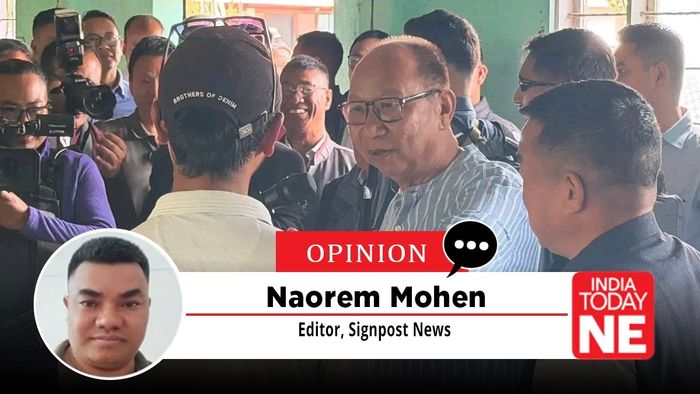
- Apr 19, 2026,
- Updated Apr 19, 2026, 2:12 PM IST
Manipur has endured unimaginable pain since May 3, 2023. Still, thousands remain displaced in relief camps, hundreds of families have lost loved ones, and the social fabric between communities lies in tatters. In this atmosphere of deep mistrust and exhaustion, the installation of Yumnam Khemchand Singh as Chief Minister on February 4, 2026, after nearly twelve long months of President’s Rule, was meant to be a tentative step towards normalcy.
The Centre had little choice but to impose direct President Rule as no stable elected government could be formed immediately. The political arrangement that enabled Yumnam Khemchand’s elevation carried a clear understanding. Kuki MLAs and their influential civil society organisations extended support for a popular government on one firm condition: no N. Biren Singh and no perceived nominee of his.
They sought a relatively neutral, acceptable face who could initiate dialogue without carrying the baggage of past confrontations. Yumnam Khemchand Singh, a senior BJP leader, former Speaker, and known for his administrative temperament rather than aggressive posturing, emerged as that consensus choice.
Y Khemchand wasted no time signalling sincerity. Even before assuming office, he undertook meaningful outreach. He visited Litan and met Kuki IDPs. Week after becoming CM, he travelled to Jiribam to engage the Hmar community, passed through Kangpokpi en route to Senapati, and later ventured into Ukhrul.
In a polarised state where some Kuki hardliners had declared “buffer zones” or exclusive “ancestral territories” that Meiteis supposedly could not enter safely, these physical visits carried symbolic weight. They demonstrated that a Meitei-led government was willing to reach across divides, listen to grievances about roads, water, healthcare, and rehabilitation, and prove that connectivity and conversation could still bridge gaps.
He sat with grieving mothers and assured them there was “no option but peace through dialogue.” These were not empty gestures; they were attempts to rebuild confidence step by step. His government also reflected the spirit of compromise. It included Kuki representation at the deputy chief ministerial level, notably Nemcha Kipgen as one of the Deputy CMs, along with Naga representation.
This “baby government” was fragile, born out of necessity after prolonged central administration. Many hoped it would at least allow governance to resume, development to restart, and violence to subside so that displaced families could dream of returning home.
However, within weeks and sometimes mere days of taking charge, the ground reality has turned bitterly disappointing. Violence has not only persisted but, in some cases, flared in shocking ways. The most horrific incident came on April 7, 2026, when suspected militants hurled a bomb into a civilian house at Tronglaobi in Bishnupur district in the dead of night. It killed two innocent Meitei children — a five-year-old boy and his five-month-old sister — as they slept, and left their mother critically injured. The tragedy sparked widespread outrage and protests across the valley.
CM Y Khemchand condemned it as a “barbaric act” aimed at destabilising his young government and derailing the peace process. He ordered a high-level probe and referred the case to the National Investigation Agency (NIA).
Just yesterday, on April 18, 2026, another shocking incident unfolded that has left the entire state stunned. A day after Chief Minister Yumnam Khemchand Singh undertook a significant peace mission to Ukhrul district — where he visited multiple villages, interacted directly with both Tangkhul Naga and Kuki residents, appealed for harmony, listened to emotional stories from women who broke down in tears, and emphasised that “there is no other option left other than dialogue” for the sake of our children’s future — Kuki militants ambushed a convoy of civilian vehicles on the Imphal-Ukhrul road (NH-202) near TM Kasom / Yaolen area around 2:30 pm.
Two innocent Tangkhul civilians were killed on the spot: Chinaoshang Shokwungnao, a 45-year-old retired soldier from the Naga Regiment hailing from Tashar village, and Yaruingam Vashum, a 42-year-old from Kharasom CV village. Several others were injured. This brazen attack came hours after the CM’s trust-building visit aimed at removing the trust deficit between Kuki and Tangkhul Naga communities in the tension-hit Litan area.
CM Khemchand strongly condemned the killings, announced ex-gratia for the victims’ families, and handed the case over to the NIA for a thorough investigation. The timing could not have been more cruel or revealing — a peace outreach met with bullets.
Even if the attacks are suspected to be from the Kuki side, Chief Minister Khemchand, for the sake of his peace initiative, has carefully avoided using the term “Kuki” in his public statements and has consistently left it open to the NIA and other law enforcement agencies to investigate thoroughly and bring out the truth without bias.
CM Y Khemchand has shown remarkable patience. He has continued outreach, met IDPs, reviewed security with the Centre, and prioritised rehabilitation. He has avoided inflammatory rhetoric and focused on dialogue. But one-sided restraint has limits when toddlers are bombed in their sleep and civilians are ambushed a day after peace missions.
The Chief Minister must now recalibrate: sustain dialogue, but enforce rule of law firmly and impartially. Fast-track probes (some already with NIA), improve security coordination without bias, and deliver visible development that reaches every community. Governance cannot survive on goodwill alone.
This pattern raises a blunt and painful question: Who truly benefits from sabotaging this baby government? If Khemchand was chosen as a neutral and approachable leader with Kuki political backing, why are elements from the Kuki side — or those operating under their broader umbrella — not restraining violence?
Why do bullets and bombs continue to target innocent civilians, including children and now Tangkhul youths and ex-servicemen, even after the Chief Minister’s outreach tours to multiple communities? What message is being sent when the government waves the white flag of dialogue and receives grenades and ambushes in return?
Several layers explain this apparent sabotage. First, there is a clear disconnect within Kuki politics. The MLAs who negotiated the political deal in Delhi do not necessarily control the more radical CSOs or armed factions operating under Suspension of Operations (SoO) frameworks. Some hardline elements appear determined to prevent the new government from stabilising.
Continued violence keeps the narrative of perpetual insecurity alive. It justifies demands for separate administration or Union Territory status, sustains extortion networks in the hills, and discourages the return of displaced persons. It also forces CM Y Khemchand into a difficult position: if he responds with firm security action, he risks being labelled “anti-Kuki”; if he remains overly restrained, he appears weak and ineffective.
Second, some factions may genuinely fear that genuine peace and functional governance would dilute their maximalist positions on territory, land rights, and constitutional safeguards. A stabilising government under Yumnam Khemchand could gradually normalise life, reopen roads, restart development projects, and reduce dependence on armed groups.
That prospect threatens those who profit from prolonged chaos — be it through illegal taxation, control over resources, or political leverage derived from victimhood narratives. But the most disturbing possibility — one every vigilant citizen of Manipur must examine carefully — points towards external calculations.
With Assembly elections scheduled for February-March 2027, the window for another spell of President’s Rule (possibly six months before polls) remains open. In the intricate politics of India’s Northeast, central agencies and Delhi-based players have long exercised significant influence.
History shows that prolonged instability has often been used to justify extended central control, reshape political equations, or manage outcomes in sensitive border states. If certain quarters in Delhi calculate that a successful or even moderately functional Khemchand Singh government does not serve their larger strategic interests — whether to reposition allies, weaken regional political assertions, or maintain tighter oversight — then selective destabilisation becomes a convenient instrument.
Allow a “baby government” to form after months of negotiation, only to let violence spike and blame fall on the state leadership. The result? Public disillusionment grows, the elected government is painted as incompetent, and President’s Rule returns under the garb of restoring order. This is not conspiracy theory; it is a pattern observed in several Northeastern states over decades.
A divided and unstable Manipur is easier to manage from the Centre than a united, assertive elected government that begins addressing core issues of land, autonomy, and equitable development. Ultimately, those who benefit from sabotaging CM Khemchand’s baby government are the radical elements on any side who thrive on division and fear by keeping communities apart.
They also include those involved in the shadow economy of illegal arms, drugs, and extortion, who would lose relevance in a peaceful and properly governed state. External players who prefer a weak and dependent Manipur over a self-confident one that can negotiate its future with strength also stand to gain. Crucially, those in the power corridors who see political or administrative advantage in discrediting moderate local leadership and extending central dominance ahead of the 2027 elections benefit as well.
Kuki MLAs and responsible CSOs who facilitated this baby government, must break the ice now. Silence or selective outrage is not the solution. If you truly backed a neutral leader for peace, then openly condemn violence against innocents and restrain armed elements within your influence. Silence only strengthens suspicion of complicity or helplessness.
Let an elected government function. Support de-escalation instead of creating pretexts for more central rule. We have already lost too much: lives, livelihoods, education for our children, and years of progress. Another cycle of President’s Rule and deepened division will only multiply the suffering.
This CM Y Khemchand’s government may be young and imperfect, but its success or failure will be seen by many as the success or failure of the peace-seeking, pragmatic voice among the Meiteis and across communities.
The coming months leading to State election in 2027 will decide our trajectory. If we allow sabotage — whether driven by local radicals, profit-seekers, or calculated external designs — to succeed, we all lose. Peace is not weakness. It demands courage — courage to restrain extremists within one’s own fold and courage to meet halfway.
CM Khemchand has taken initial steps by reaching out. The real test now is whether enough stakeholders on all sides will walk with him or continue planting obstacles on the path.
Let us not sacrifice our future at the altar of narrow political calculations or hidden agendas. The question “Who benefits?” must be answered honestly by every stakeholder. Because in the end, if peace fails, no one truly wins — except those who profit from our pain.