Who Orchestrates the Division of Manipur and the Push for a Separate Homeland for “Refugee” Kukis?
The Manipur Assembly, with its 60 seats and a clear BJP majority of 37 MLAs even without the Kuki contingent, has already surpassed the numbers required for government formation. The world will not end if these 10 legislators remain outside the cabinet or on the opposition benches—the democratic process can and should proceed without their conditional endorsement, as President's Rule has already lingered far too long since February 2025.
- Jan 15, 2026,
- Updated Jan 15, 2026, 2:49 PM IST
Is it truly justified for the 10 Kuki MLAs—seven of them from the BJP—to attach a rider to their participation in the formation of a popular government, demanding a written, time-bound commitment from the Centre and state for a separate Union Territory with legislature as a precondition? When did Kuki MLAs become bargaining chips in the hands of few CSOs?
The Manipur Assembly, with its 60 seats and a clear BJP majority of 37 MLAs even without the Kuki contingent, has already surpassed the numbers required for government formation. The world will not end if these 10 legislators remain outside the cabinet or on the opposition benches—the democratic process can and should proceed without their conditional endorsement, as President's Rule has already lingered far too long since February 2025.
This ultimatum, formalized in the January 13, 2026, Guwahati resolution by Kuki-Zo Council (KZC), Suspension of Operations (SoO) groups, and the 5 MLAs themselves, effectively holds the restoration of democratic governance in Manipur hostage to a separatist agenda that the Centre has already rejected outright.
Joining—or refusing to join—the government is not an autonomous prerogative of these individual MLAs; it is fundamentally a decision governed by the party whip, constitutional obligations, and the collective mandate they received from voters under the banner of their respective parties, primarily the BJP.
This new drama of an ultimatum—insisting on a "definitive political solution" before the 2027 Assembly elections—smacks of political blackmail rather than genuine negotiation. It revives the same separatist playbook seen since May 2023, when the same 10 Kuki MLAs first demanded a "separate administration" amid the ethnic violence, framing coexistence as impossible.
Yet, the timing raises red flags, as pressure mounts from Meitei and Naga legislators to end central rule and restore an elected government, and as BJP parleys intensify ahead of the February 14, 2026, deadline, these conditions appear designed to derail progress unless their long-standing demand for carving out a fictitious "Kukiland" is met.
Why introduce such a high-stakes rider now, when the Centre has repeatedly dismissed the UT proposal as unviable and contrary to Manipur's integrity? It risks prolonging instability, deepening ethnic divides, and undermining the very democratic institutions these MLAs were elected to serve.
At the core of this hypocrisy lies a profound question. When these MLAs—sworn in under the Constitution of India—took their oath of office, they pledged to uphold the sovereignty, unity, and territorial integrity of India, including the state of Manipur as an indivisible entity.
Demanding a separate Union Territory, which would effectively bifurcate the state along ethnic lines, directly contradicts that solemn oath. It transforms elected representatives into agents of division rather than unity, prioritizing a narrow community agenda over the broader Manipuri identity they were mandated to protect.
If protecting "land ownership" and addressing historical grievances were the true intent, constructive dialogue within the existing federal framework—through hill area autonomy enhancements or equitable development—would suffice, without resorting to ultimatums that echo threats of non-cooperation.
By conditioning their legislative duty on separatist concessions, these MLAs not only betray their oath but also the voters who elected them to serve Manipur as a whole, not to dismantle it. Until this fundamental contradiction is resolved, any claim to justification for such riders remains deeply flawed and self-serving.
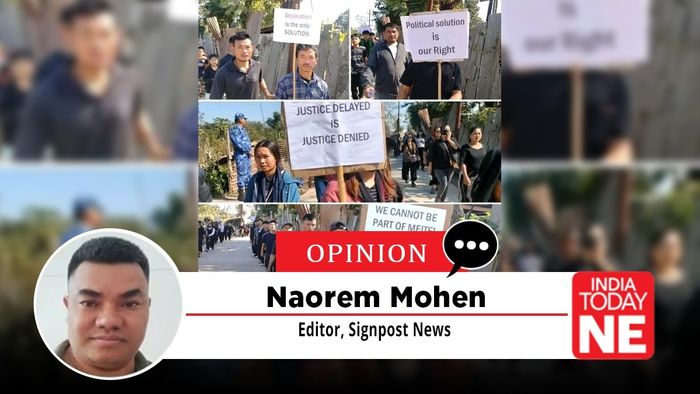
Meanwhile, hundreds of Kuki community participated in mass protest rallies on January 14, 2026 which was organized by Kuki-Zo Council and the Indigenous Tribal Leaders Forum (ITLF) across Kuki dominated districts in Manipur, including Churachandpur, Kangpokpi, Moreh, and others.
The rallies, which was held under themes like "Expedite Our Political Solution," featured large crowds marching with banners and slogans demanding a separate administration in the form of a Union Territory with legislature under Article 239A of the Indian Constitution.
Protesters emphasized that coexistence under the existing Manipur state framework is impossible after nearly three years of ethnic violence since May 2023, citing ongoing issues like displacement, insecurity, buffer zone violations, jurisdictional encroachments, and lack of protection for Kuki lands and properties in the Imphal Valley.
The ITLF/KZC spokesperson Ginza Vualzong, highlighted the "point of no return" and urged the Centre to fast-track a negotiated political settlement before the current Manipur Assembly term ends in February 2027.
These CSOs firmly rejected participation in any revived popular government in Manipur without a firm, time-bound written commitment from the Centre and state governments to expedite a negotiated political settlement.
The central question persists: Do the 10 Kuki MLAs truly intend to join the emerging popular government in Manipur, or are they bound by the stance of the Kuki CSOs?
Moreover, the prefix “Refugee” before “Kukis” in this context is neither arbitrary nor derogatory—it is a straightforward and legitimate descriptor rooted in historical migration patterns and documented realities. Kukis began arriving in Manipur in significant numbers from the 1840s onward, with continuous inflows from the Chin Hills of Burma (now Myanmar) and, to a lesser extent, the Chittagong Hill Tracts, persisting right up to the late 1967.
A portion of these later arrivals were officially recognized and provided refugee assistance by the Government of India during periods of conflict and displacement in their places of origin.
When the proposed National Register of Citizens (NRC) is eventually implemented in Manipur—likely using a base year of 1951 or 1961, as repeatedly discussed—those individuals (and in some cases their descendants) who cannot establish pre-cutoff residency or citizenship documents will face the legal obligation to leave Indian territory.
For many among them, the prospect of returning to unstable regions in Myanmar or the Chittagong Hill Tracts is not just inconvenient; it is a genuine nightmare, marked by ongoing ethnic violence, military crackdowns, and economic hardship.
This existential fear has now pushed certain sections of the community into a perceived “do-or-die” mode, driving the intensified demand for a separate administrative unit or Union Territory carved out of Manipur’s hill areas.
Far from being hidden, this underlying reality is openly reflected in the recent ultimatums issued by Kuki CSO and their 10 MLAs, who condition participation in any elected government on a time-bound “definitive political solution” before the 2027 Assembly elections—effectively making territorial separation the price of democratic normalcy in the state.
Another question that haunts every concerned citizen, policymaker, and observer is: Who is behind all these problems in Manipur? Is it a spontaneous clash of communities driven by historical grievances, or is there a more sinister agenda at play, manipulated by certain groups to sow seeds of divisions?
While the BJP-led government's policies on eviction of illegal encroachers from reserve forest, drug crackdowns, destruction of poppy plantations and SoO with Kuki militant have been portrayed as biased, they are, in fact, equitable measures aimed at restoring order.
The government's role in this saga cannot be ignored, but it deserves a fair examination. The BJP government has initiated several reforms that have been weaponized in the ethnic narrative.
First, the eviction drives from reserved forest areas. These operations, aimed at curbing illegal encroachments and preserving biodiversity, were not selective. Encroachers from Meitei, Naga, Muslim, and Kuki communities were all affected.
Reports from the Manipur Forest Department confirm that thousands of hectares were reclaimed, with evictions spanning multiple districts. For instance, in Churachandpur and Kangpokpi—predominantly Kuki areas—poppy plantations, often linked to narcotics trade, were targeted.
But similar actions occurred in Imphal Valley, impacting Meitei settlers, and in Naga-dominated Tamenglong. Why, then, has this been framed as an anti-Kuki pogrom?
The answer lies in selective storytelling, where isolated incidents are amplified to create a victimhood narrative.
Closely tied to the evictions is the "War on Drugs," a flagship initiative to eradicate poppy cultivation, which has poisoned Manipur's lands and fueled a multi-billion-rupee narcotics economy. Poppy, the raw material for opium and heroin, has devastated communities, leading to addiction epidemics and funding insurgent activities.
The state government's crackdown, involving aerial surveys, raids, and arrests, has been comprehensive. Muslim and Meitei drug lords have faced the brunt, with high-profile busts in Imphal and Thoubal districts netting tons of contraband.
Even Kuki CSOs have now endorsed the eradication of poppy in Kangpokpi, as announced in recent statements. This belated support raises eyebrows: if the community now backs the drive, why was it earlier portrayed as ethnic persecution?
The inconsistency suggests a tactical shift, perhaps to deflect blame after international scrutiny highlighted the role of hill-based plantations in the drug trade.
Another pillar of the government's strategy was the abrogation of the SoO agreement with Kuki militant groups. Signed in 2008, the SoO aimed to bring peace by halting hostilities in exchange for camps and stipends.
However, violations were rampant: kidnappings, looting on national highways, ransom demands, and threats to civilians. The Kuki National Organisation (KNO) and United People's Front (UPF) factions, including the Kuki National Front-Presidential (KNF-P), repeatedly breached ground rules.
Innocent travelers along National Highways were harassed, extorted, and sometimes killed. The government's decision to scrap the pact in 2023 was not whimsical; it followed intelligence reports and public outcry.
Parallel crackdowns on Meitei insurgents, such as the PLA, UNLF, KYKL, KCP and PREPAK demonstrate impartiality. Quite often, the operations in the valley led to arrests and neutralizations, yet these are seldom highlighted in the Kuki narrative.So, why do Kukis paint the state—and particularly the Meitei community—as aggressors?
This false narrative serves multiple purposes. It garners sympathy from national and international audiences, attracting aid from NGOs and diaspora networks.
It also justifies retaliatory violence, masking expansionist ambitions. The May 2023 violence saw over 300 Meitei temples, sacred groves, and cultural sites desecrated or destroyed. Homes, shops, and businesses in Moreh, Churachandpur, and other border areas were looted and bulldozed. Entire Meitei villages were expelled, displacing thousands.
In contrast, claims of Meitei church burnings by Kukis, while tragic, pale in scale and are often highlighted. The one-sided propaganda, disseminated through social media and sympathetic media outlets, crafts a "victim card" that obscures the aggressor's role.
Now, in 2026, as the conflict with Meiteis reaches a stalemate—with peace talks stalled and blockades easing—the focus has shifted to the Nagas.
A calculated campaign by elements within the Kuki community—fueled by Kuki militant groups and amplified by propaganda—appears to be the driving force behind the escalation, now extending its tentacles to target the Naga people after exhausting its playbook against the Meiteis.
To understand the current turmoil, we must rewind to the roots of the crisis. Manipur's ethnic demography is complex, comprising the valley-dwelling Meiteis, the hill-based Kukis, Nagas, and other tribes, each with distinct identities, land claims, and aspirations.
Tensions have simmered for decades over issues like land rights, political representation, and economic opportunities which was the false propaganda of some hill leaders and their supporters. However, the flashpoint ignited in May 2023 which spiraled into widespread violence.
What began as peaceful demonstrations quickly devolved into targeted attacks against the Meitei in Kuki dominated areas like Churachandpur, forced displacements, and a humanitarian crisis.
Official records paint a grim picture, with over 260 deaths, with more than 170 from the Meitei community and 34 still missing. Yet, the narrative peddled by Kuki CSO and their allies has been one of "genocide" against the Kukis, a claim that starkly contrasts with the disproportionate casualties on the Meitei side.
A recent public notice from the Joint Tribes Council (JTC), representing Inpui, Liangmai, Rongmei, and Zeme Nagas. On January 14, 2026, strongly condemns an incident at Ireng village on January 11 and 12, 2026. A waiting shed was vandalized with provocative graffiti threatening to kill Ireng Naga residents and burn their homes.
Shockingly, about 30 fully armed KNF-P cadres were reportedly dispatched to execute these threats. The JTC's response was very legitimate. They issue a ban on traffic in their jurisdiction and a call for non-cooperation with Kukis in trade, commerce, and social relations until an amicable resolution.
This boycott highlights the gravity—it's a protest against non-cooperation and a plea for peace, safety, and mutual respect.This attack on Ireng is no isolated skirmish; it's part of a pattern.
In May 2023, Meiteis were targeted and expelled from hill districts. Now, in January 2026, Nagas face similar intimidation. KNF-P's warnings to Nagas to vacate their ancestral lands echo the ethnic cleansing tactics used earlier.
What is the agenda? Land grabs, perhaps, to consolidate Kuki dominance in the hills for greater political leverage or control over trade routes to Myanmar. The porous border facilitates arms smuggling and narcotics, benefiting militant economies.
By expelling Meiteis and now Nagas, Kukis could aim to create a homogeneous "Kukiland," a demand voiced by Kuki organizations since the 1990s.But who are the handlers behind this orchestration?
Fingers point to external influences, rather, a deep state. Myanmar's instability, with its civil war spilling over, provides a haven for Kuki militants linked to Chin tribes across the border. Arms flow freely, as evidenced by sophisticated weapons in recent clashes.
Their propaganda machinery, including fake news mills and international lobbying, amplifies grievances while ignoring their own fault. The problems in Manipur are not organic but engineered by those benefiting from division—primarily Kuki militant elements and their enablers.
As Meiteis lick their wounds and Nagas raise alarms, it's time to expose the puppeteers. The JTC's stand is a wake-up call. If we keep on ignoring the silent invasions of "Refugee" Kukis in Manipur, it risks further balkanization. Who is behind it?
Look to those who gain from the bloodletting—the thirst for power disguised as victimhood.