Why DMU Scholars Go Hungry to Be Heard, When Government Celebrates Achievers?
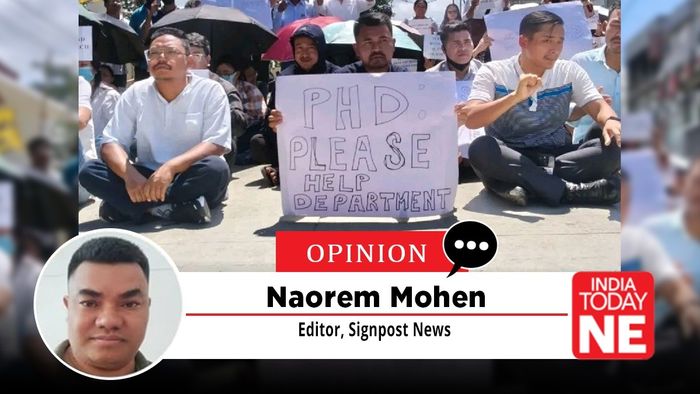
The indefinite hunger strike began on September 9 with the support of the Dhanamanjuri University Students’ Union for 2025–26. Three PhD scholars and a student leader stopped eating to demand the release of stipends which, according to the protesters, have remained unpaid for several years.
- Sep 15, 2026,
- Updated Sep 15, 2026, 12:19 PM IST
Chief Minister Yumnam Khemchand Singh honoured students from Manipur’s government schools for their performance in the Higher Secondary Examination. He presented awards and financial incentives and spoke about encouraging academic excellence. It was a good occasion. Young people who work hard deserve recognition, and a government should celebrate their success.
That was not the only occasion on which the Chief Minister publicly encouraged young achievers. On August 21, he invited 16 young students leaving Manipur for skill training and employment in Japan.
Recently, on September 11, Khemchand felicitated Yashirun Mirshad at his Secretariat for her academic achievements at the University of Huddersfield in the United Kingdom. He commended her for securing 75 per cent in her PPD Social Innovation Presentation and completing her MSc in Psychology. He wished her a bright and successful future.
Both were welcome gestures. The young people travelling to Japan deserved encouragement, and Mirshad’s academic achievement deserved recognition. But three days after the Chief Minister felicitated a scholar who had earned a degree from a British university, PhD scholars of Dhanamanjuri University were on the sixth day of a hunger strike in Imphal.
They, too, are building a future through education. They, too, are scholars. The difference is that they are studying at a university in Manipur for which CM Khemchand’s own government bears responsibility.
Why, then, must an academic achievement come from abroad before it earns the Chief Minister’s attention?
The indefinite hunger strike began on September 9 with the support of the Dhanamanjuri University Students’ Union for 2025–26. Three PhD scholars and a student leader stopped eating to demand the release of stipends which, according to the protesters, have remained unpaid for several years.
The hunger strikers include Naorem Venus of the Chemistry Department, Yeengal Leima Huidrom of the Manipuri Department and Irom Dimocha of the Economics Department. DMUSU general secretary Oinam Keba, who has pursued an MSc in Mathematics, also joined them.
Supporters and well-wishers visited the protest site as the hunger strike continued. Even Manipur MP Dr Angomcha Bimol Akoijam met the protesting students. What was reportedly absent, even on the sixth day, was any meaningful response from the state government.
Konsam Premjit, president of the Democratic Youth Front, said on September 14 that no representative of the government had approached the protesters to ask what they wanted or understand their demands. The scholars themselves accused the government of maintaining a “stoic silence” even as concern grew over the health of those refusing food.
This is where the contrast becomes difficult to ignore. The Chief Minister can make time to present gifts, offer congratulations and stand beside young achievers. But when research scholars of his state university stop eating, his government allegedly cannot even send an official to hear them.
That is more than an administrative delay. It reveals a troubling contradiction in the government’s approach to education.
Success is welcomed when it is already complete and ready to be celebrated. Students returning with foreign degrees receive public recognition. Those leaving for employment abroad receive a formal send-off. But scholars struggling inside a state university, still working towards the achievements Manipur may one day celebrate, are left to fight for basic academic support.
According to the protesters, more than 750 scholars are eligible for the stipend. They said the PhD programme at DMU began in 2022, but the scholars have not received the assistance to date.
Irom Dimocha said the absence of financial support was affecting their studies and that the scholars had been approaching the government since March. They did not begin their campaign with a hunger strike. They first pursued the matter through representations and meetings.
According to Konsam Premjit, a spot enquiry conducted by the DYF found that a Manipur Gazette notification issued on October 30, 2017, provided for stipends for PhD research scholars. Guidelines were subsequently framed, he said, but the stipend was not implemented from the beginning.
A written representation was first submitted to the Commissioner. When there was no response, a memorandum followed. When that also produced no result, representatives connected with DMU met the Chief Minister Yumnam Khemchand on July 30.
According to both Premjit and the protesting scholars, they were verbally assured that the stipend would be released in the first week of September. That week passed without payment.
The scholars said the matter was also raised as a starred question by the Opposition MLA during the recently concluded Manipur Assembly session. According to Dimocha, the Chief Minister reportedly said the government was still searching for a source from which the stipend could be provided. Premjit similarly said the reply was concluded by stating that there was “no source” of funds.
That response, the scholars said, pushed them towards the indefinite hunger strike. The government must now answer a simple question: Was an assurance given to the scholars in the July 30 meeting or not?
If it was given, why was it not honoured? If an administrative or financial obstacle emerged, why were the scholars not informed? A Chief Minister’s assurance cannot be reduced to a sentence used to end an uncomfortable meeting. It carries the authority of the government and creates a legitimate expectation among those who receive it.
The amount being sought is reportedly Rs 8,000 a month for every eligible scholar. This is not a prize, charity or political favour. It is modest academic assistance for researchers who must pay for chemicals, laptops, electronic components, field visits, travel, sample collection, data gathering, report preparation and the publication of theses, research papers and journal articles.
In many disciplines, these expenses can run into lakhs of rupees. Eight thousand rupees a month will not meet the entire cost of serious research. It can only reduce a part of the financial burden.
Research scholar Search Joy Khamrang said many DMU scholars came from financially vulnerable families. The burden of meeting research expenses without assistance affected them mentally and left them demoralised, he said. He also expressed concern over the deteriorating health of the hunger strikers.
“What are the authorities doing for this genuine demand?” Khamrang asked. His question deserves an answer.
The silence of the government, Khamrang said, had made the scholars feel neglected and treated in a “step-motherly manner”. Whether or not the government accepts that description, it cannot ignore the condition that has produced such a feeling among hundreds of young researchers at its own university.
If the government can find money for ceremonies, advertisements, official functions and countless public displays of commitment, it must explain why it cannot identify funds for modest academic assistance provided for under a government notification.
This is not an argument against honouring achievers. Yumnam Khemchand was right to felicitate Mirshad. He was right to encourage the 16 young people travelling to Japan. He was also right to recognise meritorious government-school students. But the same concern must extend to young people before they become success stories.
A government cannot celebrate scholars who return with degrees from foreign universities while neglecting those conducting research inside its own university. It cannot speak of academic excellence on a stage and plead helplessness when scholars ask for Rs 8,000 a month. It cannot encourage students to aim higher and then abandon them when they reach the highest level of formal study.
Dhanamanjuri University is not someone else’s institution. It is a state university. Its condition reflects the priorities of the Manipur government. If its scholars lack essential research support, the government cannot distance itself from their hardship.
The Democratic Students’ Alliance of Manipur (DESAM) has described the scholars’ demand as genuine, legitimate and academically justified. It has correctly stated that a fellowship is not a favour or charity but academic support that enables scholars to carry out their work with dignity and continuity. The All Manipur Students’ Union (AMSU) has also expressed solidarity and raised concerns about the shortage of basic research facilities at DMU.
CM Khemchand must now do more than offer another verbal assurance. He should meet the protesting scholars personally or immediately depute a senior minister empowered to take a decision. The health of every hunger striker must be medically examined and protected. The government should publish the relevant Gazette provision and its accompanying guidelines, disclose the number of eligible scholars and the total financial requirement, and issue a written schedule for releasing the pending fellowships.
If the government believes the scholars are not entitled to the payment, it must place its legal and administrative reasons before the public. If they are entitled to it, the money should be released without further delay. There can be no honest justification for keeping them in uncertainty while their health deteriorates.
The government should also establish a permanent and transparent mechanism to ensure that research fellowships are released regularly. Scholars should not have to submit representation after representation, seek political appointments and finally risk their health whenever a payment becomes due.
The young people travelling to Japan may build successful careers abroad. Mirshad has already brought recognition to Manipur through her achievement at the University of Huddersfield. The DMU scholars sitting on hunger strike may become Manipur’s future teachers, scientists, writers, economists and public intellectuals. Their work may help the state understand and solve problems that politics has repeatedly failed to resolve.
They should not have to leave Manipur or earn recognition abroad before their government considers them worthy of attention.
Manipur cannot garland its achievers with one hand and turn away from its struggling scholars with the other. Khemchand often speaks about the future of Manipur’s young people. Here is an opportunity to show what those words mean
If Khemchand genuinely values education, he must close this troubling gap between public encouragement and government action. He must look beyond the felicitation photograph, listen to the scholars outside his door and ensure that the promise made to them is honoured.