Why NEP 2020 and GST Matter for Rebuilding Conflict-Affected Manipur
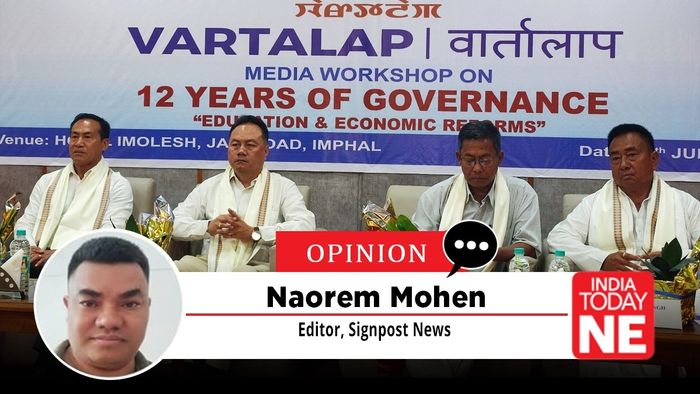
The Vartalap media workshop organised by the Press Information Bureau, Regional Office Imphal, at Hotel Imolesh in Imphal today, in connection with the completion of twelve years of governance, was more than a routine government outreach programme.
- Jun 25, 2026,
- Updated Jun 25, 2026, 2:42 PM IST
The Vartalap media workshop organised by the Press Information Bureau, Regional Office Imphal, at Hotel Imolesh in Imphal today, in connection with the completion of twelve years of governance, was more than a routine government outreach programme.
In a conflict-affected state like Manipur, such a workshop acquires larger public importance because governance can succeed only when policy reaches people in a language they understand and through institutions they trust.
The presence of Dr Th. Charanjeet Singh, MCS, Director of Information and Public Relations, Government of Manipur, as chief guest, and Dr Engam Pame, IIS, Director, PIB Regional Office Imphal, as president, gave the programme an institutional character.
The participation of Asem Bhakta Singh, president of the All Manipur Working Journalists’ Union, Khogendra Khomdram, president of the Editors Guild Manipur, Barun Ray, IRS, Assistant Commissioner, CGST Imphal, and resource persons from education and taxation sectors made the workshop relevant to the present condition of the state.
The central message was clear. Manipur cannot recover from prolonged conflict through security measures alone. The state needs economic revival, educational renewal, administrative coordination, and public awareness. In that sense, the discussion on the National Education Policy 2020 and GST was timely and necessary.
Conflict weakens more than peace. It damages markets, interrupts education, creates mistrust, discourages investment, and reduces the ability of ordinary citizens to access government schemes. In such a condition, policy communication becomes a form of public service. When people do not understand a scheme, they cannot benefit from it. When beneficiaries are not aware of their rights, intermediaries misuse the system. When implementation is weak, public trust declines.
This is where the media becomes important. Khogendra Khomdram’s observation that the motto of the media is “Tell us, we will inform the public” captured the basic democratic function of journalism. Government policies are meant for the public, but they often fail at the point of implementation and monitoring. The media must not act as a publicity arm of the government. It must act as a bridge between policy and people, while also asking whether schemes are reaching the intended beneficiaries.
Dr Th Charanjeet Singh rightly described the workshop as an important programme for improving coordination among different wings of government and the media. In Manipur’s present condition, coordination is not a technical matter. It is a requirement for public recovery. Welfare schemes, education reforms, tax reforms, and livelihood initiatives can produce results only when departments, citizens, and media institutions work with clarity.
Dr Engam Pame’s emphasis on taking government policies to the public also deserves attention. His reference to a development model that guarantees basic facilities such as drinking water, electricity, LPG, education, and financial inclusion to all reflects the larger objective of inclusive governance. In a state marked by displacement, economic disruption, and social separation, the phrase “no one is left behind” must be treated as a serious administrative test, not a ceremonial slogan.
The discussion on NEP 2020 by Prof Angom Dilip Kumar Singh of the Department of Physics, Manipur University, brought the education question into sharp focus. Manipur’s young people are among the worst affected by conflict. Schools are disrupted. University life is unsettled. Families struggle to plan the future of their children. In such a situation, education reform is not a distant national policy. It is directly linked to social healing and future stability.
NEP 2020 seeks to move Indian education away from rote learning towards competency, flexibility, creativity, skill development, and multidisciplinary learning. Prof Angom Dilip Kumar Singh explained that the earlier system carried the legacy of colonial education, designed largely to produce clerical manpower. The new framework seeks to prepare students for the 21st century and for the national goal of Viksit Bharat 2047.
For Manipur, this is particularly significant. A conflict-affected society cannot afford an education system that merely produces degree holders without skills, confidence, or employability. Students need conceptual understanding, practical exposure, critical thinking, creativity, and the ability to adapt. The NEP’s stress on ability enhancement courses, skill enhancement courses, open electives, value added courses, internships, and research exposure can help students move beyond narrow academic boundaries.
The 5+3+3+4 structure, foundational literacy and numeracy, experiential learning, multilingual approach, competency based assessment, and holistic progress cards are not abstract reforms. They address long-standing weaknesses in Indian education. They also matter deeply in Manipur, where linguistic diversity, cultural knowledge, and unequal access to quality education remain major public concerns.
The distinction between equality and equity, as highlighted in the workshop, is crucial. Equality gives everyone the same provision. Equity recognises that not everyone starts from the same place. In a state with hill and valley differences, rural and urban gaps, displacement, economic hardship, and uneven institutional access, equity is the condition for meaningful equality.
Manipur University’s implementation of NEP 2020 also deserves recognition. Its move towards multidisciplinary and interdisciplinary learning, Choice Based Credit System, Academic Bank of Credits, vocational and certificate programmes, Indian Knowledge Systems, environmental studies, ethics, NSS, ability enhancement components, and promotion of Manipuri, Sanskrit, and tribal dialects reflects an effort to align higher education with local realities and national reform.
The Academic Bank of Credits is especially important because it gives students mobility and flexibility. A student need not remain trapped by one rigid academic path. Multiple entry and exit options, credit transfer, and bachelor programmes with research create space for diverse learners. In a state where disruptions can affect continuity of education, such flexibility can become a practical support system.
The inclusion of Indian Knowledge Systems also has relevance for Manipur. Local knowledge, traditional practices, indigenous products, ecological wisdom, performing arts, language, and cultural memory must not remain outside formal education. When Prof Angom referred to examples like indigenous shampoo, the point was not nostalgia. It was about recognising that local knowledge can have academic, economic, and cultural value when studied seriously.
The second major theme of the workshop was GST. Arambam Dhaneshor Singh, Superintendent, CGST Imphal, explained GST as “one service, one tax” and described the media as a silent partner in public awareness. This is a significant observation. Tax reform is often seen as the concern of traders, accountants, and government departments. But every citizen is also a consumer. Every purchase is connected to taxation. Every business decision is shaped by compliance.
For a conflict-affected economy like Manipur, GST awareness is essential. Markets have suffered. Transport routes have been disrupted. Small businesses have faced uncertainty. New entrepreneurs need confidence. Consumers need relief. Traders need clarity. Government departments need wider compliance. Without tax awareness, the state loses revenue, businesses remain informal, and consumers remain vulnerable.
The workshop noted that GST has generated major national revenue and reduced the burden of multiple taxes that existed before its introduction on July 1, 2017. More importantly, the discussion pointed to the proposed GST 2.0 changes after the 56th Council meeting, including simplified rate structures of 5 percent and 18 percent, with luxury and sin goods proposed at 40 percent. Essential goods at zero percent, education related items at nil, and lower tax rates for many everyday items can help households directly if implemented effectively and explained properly.
The benefits for Manipur are not automatic. Low awareness remains a serious issue. Registered taxpayers are fewer than what the state economy requires. Fake input tax credit, suppressed turnover, and confusion over online business were discussed as loopholes in the state. These are not minor technical problems. They weaken public revenue and create unfair competition between compliant and non-compliant businesses.
The online marketplace discussion was important. Sellers from Manipur using platforms such as Amazon or Flipkart are entering a wider business system. Inter-state sales, IGST, tax collection at source, and central account distribution are not easy subjects for small entrepreneurs. Media can help simplify these issues for local traders, artisans, start-ups, and consumers.
GST can support Manipur’s economy if awareness expands beyond official offices. Local wood industries, handicrafts, textiles, footwear, packaging, toys, sports goods, health insurance, healthcare, mobility, gyms, and small enterprises need clear information. Tax reform must be translated into local business confidence.
This is why NEP 2020 and GST belong together in a media workshop on governance. Education reform prepares human capital. GST reform strengthens economic formalisation. One creates skilled citizens. The other creates a more transparent market. One prepares youth for future employment and entrepreneurship. The other improves revenue, compliance, and business credibility.
For Manipur, the link between education and economy cannot be ignored. A young person trained under a flexible, skill based education system can become an entrepreneur, researcher, teacher, artisan, service provider, or professional. But that same person also needs a functioning market, fair taxation, credit access, digital literacy, and public order. Education without economic opportunity produces frustration. Economic reform without educated citizens produces uneven growth.
The role of the media is therefore central. Pushpa Maibam’s request that the media promote NEP 2020 during the admission season was appropriate because students and parents require timely information. Asem Bhakta Singh’s assurance that media would help disseminate government policies to the public reflected the public duty of journalism. But media support must be intelligent, not mechanical. It must explain, question, verify, and follow up.
In conflict Manipur, government communication cannot remain formal. It must be continuous, clear, and accountable. Workshops like Vartalap are necessary because they open a space for interaction between officials and journalists. They help reporters understand technical subjects. They also remind officials that public policy succeeds only when people can see its benefit.
The way forward is practical. PIB, CGST, universities, media bodies, and civil society institutions must continue such dialogues at district levels. NEP 2020 should be explained to students, parents, teachers, and local communities before and during admission periods. GST should be explained to traders, small businesses, artisans, women entrepreneurs, online sellers, and consumers through simple local language communication.
Manipur’s revival will require peace, but peace alone will not be enough. The state also needs classrooms that prepare students for the future and markets that allow businesses to grow with fairness. NEP 2020 and GST are important because they address these two pillars of recovery. One reforms learning. The other reforms economic participation.
The PIB Imphal Vartalap was therefore not only a media workshop. It was a reminder that governance must travel from policy documents to households, classrooms, shops, markets, and young minds. In a wounded society, information itself can become a tool of recovery when it is accurate, accessible, and responsibly communicated.
(The views expressed in this article are those of the author and do not necessarily reflect the views of India Today NE or its affiliates.)