Why Reserve Forests Must Be Saved from Religious Encroachment for Peaceful Coexistence
No one is against mosques—or temples or churches—built on lawful private land. The anger is aimed at something colder and more calculated: plant a religious structure on forest soil, let it gain sanctity over time, then dare the state to touch it.
- Dec 02, 2025,
- Updated Dec 02, 2025, 12:49 PM IST
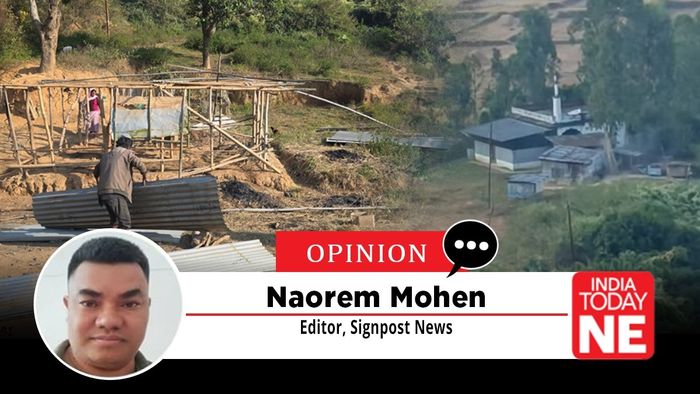
Over the past few years in Manipur, a pattern has become painfully familiar in the Nongmaiching and Heingang Reserve Forests, a concrete masjid rises deep inside protected territory. When eviction teams arrive, the surrounding huts and cattle sheds come down fast, yet the masjid sometimes stands—for practical reasons, for extra paperwork, or simply because no one wants to light the next spark. One photograph is all it takes. Within hours the image is everywhere on Social Media, suspicion hardens, and another round of communal war begins in the comment section of the post.
No one is against mosques—or temples or churches—built on lawful private land. The anger is aimed at something colder and more calculated: plant a religious structure on forest soil, let it gain sanctity over time, then dare the state to touch it. An act of encroachment is deliberately turned into a test of communal tolerance. An ecological crime becomes a ready-made communal flashpoint. That is not devotion; it is a strategy that endangers both the forest and the peace we all have to live with.
The same strategy is quietly at work across the Northeast. In the reserve forests of Assam, Arunachal Pradesh, and Manipur, permanent concrete mosques and madrasas keep appearing where no construction was ever permitted. A modest prayer shed today becomes a full settlement tomorrow, often backed by freshly created waqf papers or trust deeds.
What starts small ends up claiming hundreds of hectares of protected land. Critics call it “Land Jihad”: the systematic use of religious structures to seize and hold public forest. The evidence is no longer scattered or anecdotal; it is there on satellite images, in eviction notices, and in the growing list of demolished structures that once carried a religious name.
When the same forest department that bulldozes new Meitei temple complexes in Tharoisibi Lok or files offence reports against illegal temple structures hesitates before a concrete mosque, the perception of double standards deepens. Unless this breach is stopped uniformly and without fear of the “communal” label, the Northeast’s green lungs and its fragile social fabric will pay the price together.
These reserved forests in the Country are not merely patches of green; they are ecological lifelines, biodiversity sanctuaries, and the shared heritage of future generations. When any community—irrespective of faith—encroaches upon these protected areas and erects permanent religious structures, it violates not only the Indian Forest Act and the Forest (Conservation) Act but also endangers fragile ecosystems.
Also Read: A Meitei IDP Father’s Cry from the Relief Camp
At its worst, when illegal religious structures are shielded behind claims of faith, routine law-enforcement is swiftly recast as a communal assault. What should be a straightforward administrative action—clearing encroached forest land—gets transformed into a polarizing spectacle. Mistrust deepens in an already fragile region, and opportunistic politicians rush in to harvest votes from the resulting anger. An ecological violation is thus converted into a permanent communal grievance, setting communities against one another for generations. That is a price no forest, and no society, should ever have to pay.
Recent incidents in Assam, Arunachal Pradesh, Manipur, Maharashtra, and elsewhere reveal a troubling pattern: illegal construction of mosques, dargahs, churches, temples, and community halls inside reserve forests, followed by selective sensitivity when eviction drives begin.
In Assam’s Lutumari Forest Reserve, authorities evicted nearly 1,700 families who had occupied 5,962 bighas of protected land over decades. A mosque in the encroached zone was demolished after residents offered final prayers. Officials insisted the action was religion-neutral—every occupation inside reserved forest is illegal. Yet the visuals of a bulldozed mosque inevitably acquired a communal hue in certain narratives.
A similar script unfolded in Arunachal Pradesh, where indigenous groups have protested unauthorized religious structures built by settlers. Encouragingly, a Muslim citizen from the state publicly urged his community to refrain from constructing mosques or madrasas without permission and to respect indigenous concerns—a rare and welcome voice of reason that deserves amplification.
In Manipur, the picture is equally revealing. Data submitted by the Forest Department to the state government (2017–2023) shows 291 illegal structures evicted from reserved and protected forests. These belonged to multiple communities: 116 to Muslims, 59 to Kuki, 56 to Meitei, 35 to Kabui, 22 to Nepali, and 3 to Chiru Naga. In other words, encroachment cuts across religious and ethnic lines.
Yet public memory is selective. When structures linked to tribal communities are removed—as in K Songjang village (2023)—protests escalate rapidly, sometimes turning violent. When a concrete mosque in Nongmaiching Reserve Forest escapes demolition while nearby cattle sheds and huts are razed, eyebrows are raised and conspiracy theories of “land jihad” gain currency. Such inconsistencies fuel suspicion.
How does a permanent concrete masjid come up in a reserve forest without the local beat officer or forest guard noticing? If a Preliminary Offence Report was promptly filed in September 2025 against an illegal temple and community hall in Khamenlok-Gwaltabi RF, why is similar vigilance not visible in every case? Selective enforcement—or the perception of it—is the surest way to turn an administrative issue into a communal flashpoint.
Critics who cry bias whenever a mosque is (for the moment) left standing should look at the full picture instead of cherry-picking one photograph. The same Forest Department teams that skipped a concrete masjid in Kobithabi during one particular drive are the ones who, just months earlier, filed a Preliminary Offence Report against a newly built Meitei ritual temple and community hall in Compartment 26 of Khamenlok-Gwaltabi Reserved Forest.
And if anyone still doubts the Forest Department’s impartiality, just look at what happened in the very same Nongmaiching hills in July 2018.On the first day, bulldozers flattened 74 houses at Awaching/Kshetri Bengoon. A mosque standing in the same encroached area was left untouched that day.
The very next morning, the same team moved barely a few kilometres away to Tharoisibi Lok and tore down the entire newly built Meitei religious complex: “Ima Leishem Enat Loishang” and “Nongpok Chingu Thong Thalo Sipi Lok.” Brick walls, residential quarters, community halls, everything erected by a Meitei organisation came down without hesitation. Only the small, older shrine inside the complex was spared for the moment.
One day a mosque is passed over, the next day a Meitei centre is razed. In both cases the actual places of worship were handled with visible caution, while the clearly illegal modern constructions around them were not spared. That is not favouritism; that is a department following the same practical playbook across communities: document properly, give people time to remove belongings, then dismantle what the law says must go.
The officers on the ground are not checking which god is being prayed to; they are checking survey maps, reservation notifications, and construction dates. The record is clear: when the structure is recent and illegal, no faith gets a free pass.
The Forest Department acts decisively, it does not spare recent constructions simply because they carry a Hindu or Sanamahi label. The pattern is consistent: permanent new complexes built in violation of law are dismantled regardless of who builds them; older or symbolically significant shrines are often handled with greater sensitivity or deferred for separate legal processes.
This brings us to a deeper and legitimately sensitive distinction that must be made with clarity and mutual respect.
Long before the Indian Forest Act of 1927 drew modern boundaries, the sacred groves and hill deities (Umang Lais) of the Meitei community—and analogous sacred natural sites of Schedule Caste—were already part of the living cultural and spiritual ethos of the land.
Various sites associated with Nongmaijing, Koubru, Thangjing, or the sacred groves of the Tangkhul, Kabui, and other tribes predate colonial forestry laws by centuries. For the indigenous communities of Manipur, these are not encroachments; they are the abodes of the original guardians of the land. The Meiteis and the hill tribes do not consider their ancestral deities as trespassers on their own hills—they are the owners and protectors of those very forests in indigenous cosmology.
This historical and cultural reality is precisely what indigenous movements in Arunachal Pradesh are asserting today: pre-existing sacred relationships with the land must be distinguished from post-1950 or post-1970 religious constructions that accompany demographic influx.
The same principle applies in Manipur. No one seriously demands the removal of centuries-old lai shrines at Koubru or the ancient sacred sites inside what are now notified reserve forests. But a concrete mosque built in 2015, a church erected in 2005, or even a new Sanamahi temple-complex developed after 2020 inside a notified reserve forest stands on entirely different ground—both legally and, for many indigenous people, ethically.
The way out of this mess is actually very simple—and it has already been proved to work when done right.Evict promptly, evict transparently, and evict everyone the same way. Give clear notices well in advance, allow people time to remove their belongings, document every structure properly, then bring down whatever is illegal—house, shop, cattle shed, community hall, mosque, temple, church—without pausing for photographs or speeches.
Besides, the Politicians must stop turning eviction sites into vote-harvesting grounds. Promising encroachers that their illegal houses, farms, or masjids will be “saved” if they vote a certain way is pure deception. They know no one can legally defy the Indian Forest Act or Supreme Court orders, yet they make these promises, delay peaceful vacation, and vanish when bulldozers finally roll in. This shameless vote-bank game is the main reason small encroachments balloon into permanent settlements and fresh communal wounds. Real leaders would speak the truth upfront: “This is reserve forest. Vacate now with dignity and we will help you resettle legally.”
The government must also apply the forest law the same way to everyone: if a structure went up illegally after the forest was reserved, it comes down—mosque, church, or temple, no debate.At the same time, give formal recognition and protection to the genuinely ancient sacred sites—the old Umang Lais, the pre-1927 groves and hill shrines that were already there when the British drew their lines on the map.
The Forest Rights Act, 2006 already allows this; the Northeast just needs to use it properly and transparently.Community and religious leaders, especially from faiths that reached these hills in the last century or two, have a duty to speak plainly: putting up new places of worship inside reserve forests is not devotion; it is destruction wrapped in prayer, and it drags everyone into conflict.And finally, the rest of us must stop letting nuance be shouted down.
This is not about hurting anyone’s faith; it is about preventing faith from being used as a permanent trigger for conflict. When a religious structure (whether a mosque, temple, church, or shrine) is deliberately built on protected forest land, the damage is not limited to a few acres of lost trees. It is a time bomb. Ten or twenty years later, when the Forest Department finally gathers the courage to act, that structure will no longer be seen as an illegal building; it will be seen as a sacred symbol.
The bulldozer will become a communal weapon in the eyes of millions, and a purely administrative act will be turned into a deep, lasting wound. We have watched this story repeat itself across Assam, Manipur, and Arunachal. The forest suffers silently first; society pays the heavier price later.
Protecting forests and honouring indigenous sacred geography is not communalism. Pretending that a concrete building put up in 2015 is the same as a centuries-old Umang lai shrine—that is what actually poisons peace.
The Country' beauty lies in its many beliefs, but forests are not the place to prove it. Let every community pray in peace on land that truly belongs to them. The hills themselves already belong to the old spirits who guarded them long before any of us arrived. Respect the law, respect that older claim, and both the forest and our shared future will stay safe.
Peaceful coexistence in the Northeast is fragile and precious precisely because we are so diverse. That diversity can only survive if every community agrees to play by the same rules on land that belongs to no one tribe or religion, but to all of us and to our children.
Reserve forests must remain exactly that—reserved. Reserved for clean air, for water that flows down to valley and hill alike, for the plants and animals that have no vote and no voice, and for a future in which no child grows up learning to hate another community because a patch of green became a battlefield.
Let every faith have its rightful place on lawful ground. But the moment a religious flag is raised on illegally occupied forest soil, it ceases to be a symbol of devotion and becomes a threat to peace. Protecting these reserve forests firmly, fairly, and without exception is therefore the most secular, most inclusive thing any government can do!