Why Suraj Khawas Should Have Defended Anjel Chakma?
As someone often perceived as "Northeastern" or facing similar racial prejudices himself, Khawas had a moral duty to stand against the racist slurs hurled at the Chakma brothers, rather than joining the group that escalated a minor dispute into fatal violence.
- Jan 04, 2026,
- Updated Jan 04, 2026, 3:39 PM IST
In the tragic case of Anjel Chakma's brutal assault and subsequent death in Dehradun, Suraj Khawas—one of the key accused from Manipur with a Nepali-origin surname—stands accused not just of participating in the attack, but of betraying shared bonds of identity.
As someone often perceived as "Northeastern" or facing similar racial prejudices himself, Khawas had a moral duty to stand against the racist slurs hurled at the Chakma brothers, rather than joining the group that escalated a minor dispute into fatal violence.
Instead, he failed as a fellow Northeasterner, as a potential ally against mainland bigotry, and as an Indian upholding unity in diversity—allowing hate to prevail where solidarity could have saved a life.
It doesn't "sound right" at first glance, and that's exactly why this case is so tragic and revealing. A group of young Pahadi boys from Uttarakhand and a Nepali from Manipur, allegedly hurling slurs like "Chinki", "Chinese", and "Momo" at a Chakma student from Tripura, feels incongruous only if we assume that racism requires attackers to look completely different from the victim.
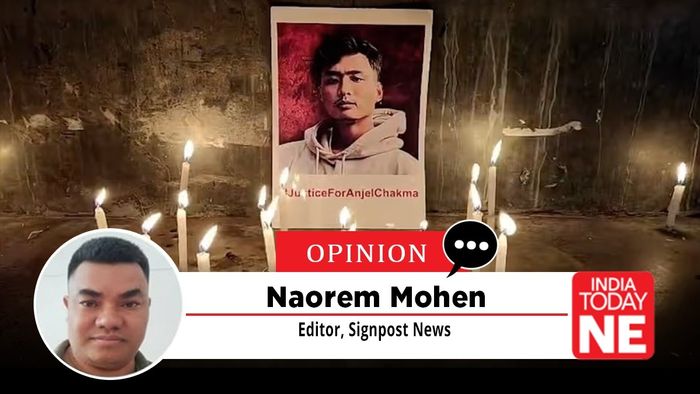
The senseless and brutal murder of Anjel Chakma, a 24-year-old MBA student from Tripura's Unakoti district, in Dehradun on December 9, 2025, has shaken the nation. Anjel, along with his younger brother Michael, faced a group of six young men inthe Selaqui market while buying groceries.
What began as an argument escalated into a fatal assault—Anjel suffered severe stab wounds to his neck and spine from a knife and blows from a brass bracelet, fighting for life until he succumbed on December 26.
But prejudice isn't logical; it's rooted in ignorance, stereotypes, and the perception of "otherness" based on facial features.Many people from Northeast India have Mongoloid/East Asian-like features due to historical ancestry.
In mainland India's dominant narrative, those features are often stereotyped as "foreign" or "Chinese"—hence the slurs. Uttarakhand Pahadis (Garhwalis and Kumaonis) are primarily living in the Himalayan foothills means there's historical admixture with Tibeto-Burman groups.
Some Pahadis do have subtle or pronounced East Asian-influenced features (high cheekbones, epicanthic folds, etc.), especially in border areas, but the majority don't fit the stereotype that triggers these specific slurs.
In this incident, the attackers (five local Dehradun youths + one Nepali from Manipur) reportedly targeted Anjel and Michael Chakma precisely because their appearance stood out as "Northeast-looking."
The eyewitness account (from Michael, the brother) and family statements consistently describe the slurs as the trigger: the group mocked them as "Chinese" and "Momo," Anjel replied "We are Indians too," and violence escalated.
Even if some attackers had mixed Himalayan roots, the prejudice here is about perceiving the victims as "not Indian enough" due to their features—a mindset that sadly persists across many parts of the country, including among fellow hill communities.
Yet, amid demands for justice, a disturbing secondary discrimination has unfolded—one perpetrated by Uttarakhand police statements and echoed in national media coverage. Authorities and headlines have repeatedly singled out Suraj Khawas, aged 22, as "a resident of Manipur," "Manipuri youth," or the host of a "birthday party by a Manipuri resident."
This framing drags an entire state and its people into the narrative, while barely mentioning the local origins of the other five accused. This selective emphasis is not mere reporting; it is a form of bias that "others" Northeast communities further, distracting from the core racism Anjel faced and perpetuating stereotypes.
The Dehradun police initially downplayed the racial angle, citing the "diverse" backgrounds of the accused (one from the Nepali community in Manipur) as proof it couldn't be racist. Activists called this reductive: racism doesn't vanish just because perpetrators aren't stereotypical "mainland plains" people; internalised bias and ignorance about Northeast identities can exist anywhere.
This case painfully shows how deep-rooted these stereotypes are—even in the hills, people with stronger Mongoloid features face the same "othering." It's not about the attackers' looks matching perfectly; it's about a toxic view that equates certain Indian faces with "foreign."Justice for Anjel demands recognising this as racial hate, not just a random fight.
The six accused are: Avinash Negi (from Sahaspur, Dehradun), Sumit Kumar (from Tilwadi/Selakui, Dehradun), Suraj Khawas (from Irang Part I in Kangpokpi district, Manipur, residing in Dehradun), Shaurya (from Dhulkot, Dehradun), Ayush Badoni (from Selakui, Dehradun), and the absconding Yagya Awasthi (who ran away to Nepal).
Five are locals to Dehradun/Uttarakhand; only Suraj Khawas is from outside. Yet, police press releases and media often lead with Suraj's Manipuri connection, implying the incident revolved around him. Dehradun SSP Ajai Singh used this to outright deny a racial motive: since one accused (Suraj Khawas) is from Manipur and another (Yagya Awasthi) Nepali-origin, racism is unlikely. This logic has been widely criticised as "reductive" by Northeast activists and scholars.
Racism stems from prejudice against perceived "otherness," not requiring attackers to be from a stereotypical "mainland" background.This selective spotlight on Suraj' Khawas' s origins—while downplaying the locals'—is discriminatory.
Why frame headlines around "Manipuri youth and friends" or a "party hosted by a Manipuri"? Why not equally note "local Dehradun youths" for the majority? Portraying Suraj Khawas merely as a "Manipuri settler" while obscuring his Gorkha identity misleads, risks inflaming regional tensions, and scapegoats Manipur unnecessarily.
It continues the very "othering" Anjel Chakma suffered.In mainland India's gaze, communities along the Himalayan foothills and bordering China and Myanmar—from Ladakh, Uttarakhand, Sikkim, Darjeeling to Arunachal, Manipur, and Mizoram—often appear "extraordinary and different." Many Pahadis (hill people)—Garhwalis, Kumaonis, Ladakhis, Gorkhas/Nepalis, and Northeast peoples—share Mongoloid ancestry and features.
We are frequently treated as outsiders despite our integral role in India's story. The Uttarakhand administration's dismissal of racism here rings hollow when their own narrative reinforces bias by highlighting one accused's Manipur link. Suraj Khawas hails from the Nepali Gorkha community in Manipur's Kangpokpi district—a community whose bonds with Manipur span over two centuries, proving our shared Himalayan heritage.
The Nepali entry into Manipur traces to at least 1819, with significant settlement under Maharaja Gambhir Singh (reigned 1825–1834). Devastated by repeated Burmese invasions (the Seven Years' Devastation, 1819–1826), Manipur needed military rebuilding. Gambhir Singh, with British aid, raised a new army—the "Victoria Paltan"—heavily recruiting Gorkha soldiers from Sylhet (then including parts of modern Assam).
In 1824, Gorkhas from the 16th Sylhet Local Battalion (later 8th Gorkha Rifles) joined his Police Levy. The name "Paltan" itself derives from the Nepali corruption of "platoon," reflecting their preponderance. These Gorkhas proved loyal defenders, earning trust as protectors of British Political Agents, cooks, milkmen, traders, and agriculturists. By the late 19th century, more battalions (23rd, 43rd, 44th Gorkha Rifles) were stationed in Manipur, with hundreds transferred from Golaghat and Silchar in Assam. Maharaja Chandrakirti's reign (1850–1886) saw further influxes.
The pinnacle of loyalty came in the Anglo-Manipur War of 1891. Saheed Subedar Niranjan Singh Chhetri, originally a sepoy in British 34th Native Infantry, deserted to join Manipur's forces. Appointed Subedar by Prince Bir Tikendrajit—a trusted confidant—he fought valiantly for Manipur's sovereignty. Arrested May 2, 1891, he was hanged by the British on June 8, 1891, at Kangla's western gate.
In 1941, Maharaja Bodhachandra married Nepali princess Ishwari Devi (daughter of Prince Ramraja of Ramnagar, granddaughter of Nepal's Prime Minister). Sixty attendants accompanied her, settling in Kanglatongbi. Post-1945, INA veterans also made Manipur home. The 2011 Census counted 63,756 Nepalis in Manipur, projected near 80,000 today.
Nepali are inseparable from Manipur. From soldiers, settlers, heroes, singers etc. Singling out Suraj Khawas as "Manipuri" while hiding his Gorkha roots divides rather than unites. Why not "Nepali from Manipur" in headlines?
While the law must take its course and deliver appropriate punishment to all the accused based on their individual roles and evidence, the harshest moral condemnation—beyond mere legal consequences—should fall on Suraj Khawas.
He, a young man from Nepali community of Manipur, shares the very Himalayan-Mongoloid features that have long made Northeast Indians targets of racist abuse across mainland cities. He belongs to a people who have endured slurs like “Chinki,” “Chinese,” and “momo”—the same venom allegedly hurled at Anjel Chakma moments before the fatal attack.
Suraj Khawas himself, living as a migrant in Dehradun, would have known—or should have known—the sting of being “othered” for his appearance.Even if the local Dehradun boys were the ones who initiated the intimidation and hurled the racist taunts, Suraj Khawas—standing there as one of the group—had a clear moral duty to step forward and defend the Chakma brothers.
In that moment, when Anjel and Michael were being mocked for the very features he himself carries, solidarity demanded that he intervene, de-escalate, or at least refuse to join in. Instead, he allegedly participated in the assault that followed.
Yet, according to the charges, he stood among those who mocked and assaulted a fellow Northeast brother over those exact features. In betraying the unspoken solidarity born of shared marginalisation, he failed his own community profoundly.
Anjel Chakma’s retort—“We are Indians too”—should have resonated with Suraj as a mirror of his own likely experiences. Instead, he allegedly participated in an act that reinforced the very prejudice his people have suffered.
Suraj Khawas has profoundly failed every Manipuri who reveres the revered Saheed Subedar Niranjan Singh Chhetri—the brave Nepali hero who sacrificed his life in the Anglo-Manipur War of 1891, embodying unbreakable solidarity between Manipuris and the Nepali community against colonial oppression. By aligning with a group hurling racist slurs at fellow Northeasterners like Anjel Chakma, Khawas betrayed that historic legacy of unity and brotherhood, choosing division over the shared spirit of resistance that Chhetri so valiantly represented.
This is not just a crime against an individual; for someone from within the broader Northeast-Himalayan fold, it is a deeper betrayal.