When the State Stays Silent: ITLF Bans and “South Nagaland” Go Unchallenged
What alarms us most right now is the utter silence of the new Manipur government in the face of the Indigenous Tribal Leaders’ Forum (ITLF) diktat that bluntly prohibits Meiteis from entering Kuki inhabited areas until the demand for a Political solution is granted.

- Feb 17, 2026,
- Updated Feb 17, 2026, 5:29 PM IST

What alarms us most right now is the utter silence of the new Manipur government in the face of the Indigenous Tribal Leaders’ Forum (ITLF) diktat that bluntly prohibits Meiteis from entering Kuki inhabited areas until the demand for a Political solution is granted.
This exclusionary edict has been repeated through press releases and public statements ever since the violence peaked in May 2023, and it was reaffirmed as recently as February 2026. In practice, it enforces invisible security zones and institutionalizes ethnic segregation right inside the state.
Yet from Chief Minister Yumnam Khemchand Singh and his administration there has been no condemnation, no rebuttal, not even a carefully worded statement pointing out that such a restriction violates every Manipuri’s right to move freely within their own state.
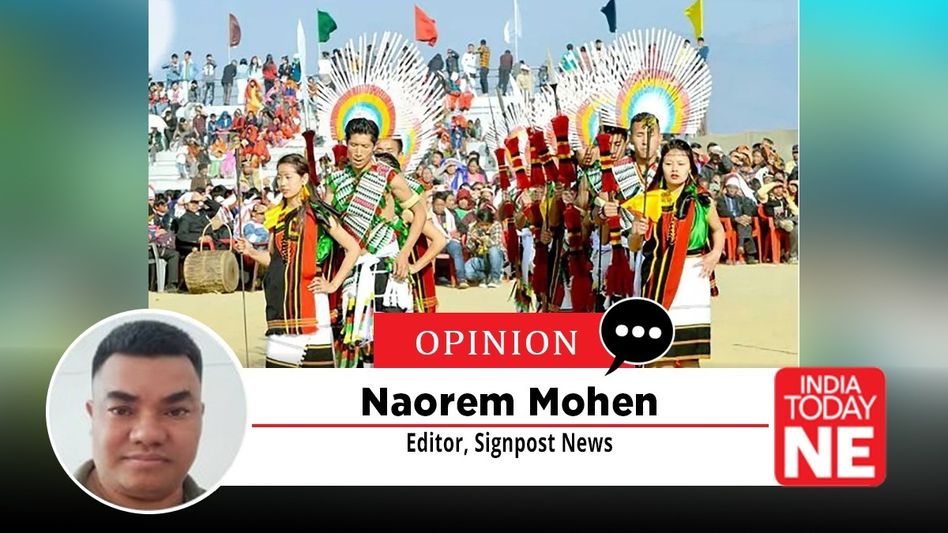
The problem doesn’t stop there. During the recent Lui-Ngai-Ni festival in Ukhrul on 15 February, Nagaland MLA and NPF Central Secretary General Achumbemo Kikon openly reiterated the old call for “South Nagaland”—a unification of Naga-inhabited territories that would carve chunks out of present-day Manipur.
He also mentioned about "Naga Homeland" in the presence of our own Deputy Chief Minister Losii Dikho, who was there as a guest of honour. What should have been a celebration of Naga culture turned into yet another public platform for questioning Manipur’s boundaries.
And again, silence. No clarification from the state secretariat, no distancing remark, nothing. When a senior cabinet minister sits through such a statement without the government issuing even a pro-forma defence of territorial integrity, people naturally ask: whose side is the administration really on?
This kind of official silence is not neutral. It is corrosive. It is read as weakness by some, as calculated appeasement by others, and as betrayal by those in the valley who already feel cornered. A government that cannot or will not respond firmly to open challenges, whether they come in the form of entry bans or irredentist speeches, quickly loses the moral authority to win the trust of the people.
Also Read: Tragic Fate of Abujam Ongbi Ibemhal, First Meitei Victim of 2023, and Husband Abujam Sajou's Death in Exile
Manipur simply cannot afford another administration that purchases short-term quiet by pretending these existential threats do not exist.
That deafening quiet sends a chilling message. Either the government is tacitly accepting ignoring as the best formula for peace or it has decided that confronting it is politically too risky. Either way, the silence only emboldens those pushing separatist lines and steadily erodes whatever trust remains among ordinary people.
The new government took office on February 4, 2026, ending almost a year of President’s Rule. Everyone hoped the change would bring fresh energy to heal the wounds left by more than two and a half years of ethnic violence between Meiteis and Kuki communities, violence that killed hundreds, displaced tens of thousands, and turned neighbour against neighbour.
Instead, in just a fortnight we are seeing a pattern of avoidance that feels all too familiar. We refuse to mistake this quiet for peace. Silence here is tactical, perhaps strategic, but it solves nothing. It sidesteps the real questions.
Has the new leadership quietly conceded ground to hill-based demands in exchange for breathing space? Or is it simply afraid of being targeted the way former CM N Biren Singh was the moment he spoke plainly about drugs, forest encroachments, and illegal immigration?
Look at the recent past for the answer. Congress leader Okram Ibobi Singh governed for fifteen years without major friction from Kuki groups largely because his administration never used the vocabulary that later became explosive—“war on drugs”, “eviction of encroachers from reserved forests”, “deportation of illegal immigrants”, or “Kuki narco-terrorists”.
However, N. Biren Singh chose a different path. He spoke those words loudly and repeatedly, launched visible campaigns, and became the most reviled Meitei leader in the eyes of many in the hills and their diaspora.
The contrast is stark, and the new Chief Minister Yumnam Khemchand seems to have studied it carefully. So far he has avoided every triggering phrase. His Jiribam visit was couched in soft, reconciliatory language. But when he accidentally—or perhaps not so accidentally—referred to Kalinagar Part 2 (a Meitei village in official records) as “Hmar Veng”, a term never gazetted, there was no correction, no uproar from valley organisations, and the matter simply vanished.
That small episode felt like a quiet test balloon, and the lack of pushback only encouraged those who prefer alternative place names.These are not trivial slips. They form part of a larger pattern of symbolic concessions and selective muteness that keeps one side calm while leaving the other anxious.
The cabinet itself reflects the balancing act, where Nemcha Kipgen as Deputy Chief Minister gives historic representation to a Kuki woman; Losii Dikho brings Naga People’s Front into the fold. Fine gestures, but inclusivity cannot mean pleasing a few communities at the expense of other.
I want to be clear and urging Chief Minister Khemchand to find his voice, especially for the Meitei community. Championing the legitimate security and identity concerns of the Meiteis is not communalism. It is the bare minimum required to hold Manipur together.
The Meiteis form the demographic, historical, and cultural spine of the state. When they feel secure, the entire state stands stronger. A confident valley becomes the stable base from which real dialogue with the hills can begin. Leadership that bravely addresses Meitei anxieties while remaining fair to everyone else will earn respect across lines, not just polite nods from one side.
If this administration continues to believe that dodging hard issues will somehow deliver peace, it is repeating the errors of the past. Selective appeasement never builds unity; it only postpones the next explosion. Manipur stands at a fork: another chapter of valley marginalisation, or the difficult but necessary work of governing for all without favouritism.
Real reconciliation needs plain talk, about forest rights, immigration checks, drug eradication, and balanced development. It means clearly rejecting any narrative that treats Manipur as a divisible entity while still guaranteeing hill communities dignity and representation.
The current hush from some Kuki leaders may feel like approval of the new restraint, but it could just as easily mask preparations for bigger demands.The coming months will tell us whether this government has the courage to confront uncomfortable realities or whether it will settle for the easy quiet that has failed so many times before.
Today, the people of Manipur demand a strong, unequivocal clarification from the State unit of NPF regarding the highly provocative and unacceptable statements made by Nagaland MLA and NPF Secretary General Achumbemo Kikon.
His repeated references to "South Nagaland" and the so-called "Naga homeland" encroaching upon sovereign territory within Manipur represent a blatant affront to the state's integrity and unity.Such irredentist rhetoric, which seeks to portray parts of Manipur as an extension of a greater Naga domain, is not only inflammatory but dangerous, threatening the hard-earned peace, territorial wholeness, and constitutional sanctity of Manipur.
Let this new government made a crystal clear. Manipur's integrity cannot be taken for granted, nor will it ever be compromised or negotiated away to appease divisive agendas.
Peace is not the sound of no one complaining; it is justice, mutual respect, and an unbreakable commitment to one Manipur. Anything short of that invites the return of louder, more painful days. The people, every single community, deserve far better.
The views expressed in this article are those of the author and do not necessarily reflect the views of India Today NE or its affiliates.