Kokborok in Roman Script, Forging an Unbreakable Shield for Tripura's Indigenous Identity
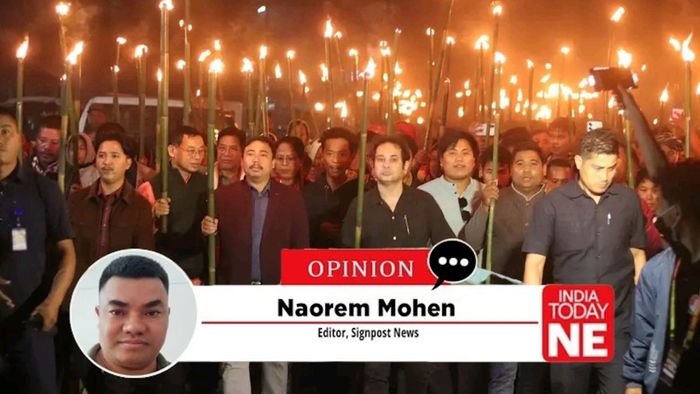
The bustling streets and serene villages in Tripura was lighted with a flame of resistance which burns brightly—literally and figuratively—through the Homchang Rallies, where torches symbolize the unyielding spirit of the indigenous Tipra people.
- Dec 19, 2025,
- Updated Dec 19, 2025, 8:11 PM IST
The bustling streets and serene villages in Tripura was lighted with a flame of resistance which burns brightly—literally and figuratively—through the Homchang Rallies, where torches symbolize the unyielding spirit of the indigenous Tipra people.
These rallies have swept across the state, from the urban pulse of Agartala to the remote subdivisions like Karbook, Mandwi, and Santirbazar, uniting thousands in a chorus for the adoption of the Roman script for Kokborok.
This is no mere linguistic preference; it is a clarion call to preserve the essence of Tipra identity against the tides of assimilation, demographic shifts, and governmental impositions that threaten to erode a centuries-old heritage.
The indigenous people of Tripura, who proudly identify as Tipra, speak Kokborok as their mother tongue, a language that encapsulates their rich cultural and historical tapestry. Kokborok, belonging to the Tibeto-Burman family, is spoken by over a million individuals, primarily the Tripuri community, and serves as a vital link to their folklore, traditions, and worldview.
However, Tripura's demographic has been dramatically altered by waves of Bengali refugees fleeing political instability in neighboring Bangladesh and erstwhile East Pakistan. This influx, beginning in the mid-20th century, has transformed the state from an indigenous-majority region to one where Bengalis now dominate, comprising around 70% of the population.
Such shifts have led to the imposition of the Bengali script for writing Kokborok, sparking widespread resentment among indigenous communities who advocate fiercely for the Roman script. This preference is rooted in a desire to preserve linguistic autonomy and resist cultural assimilation, as the Bengali script is intrinsically tied to the dominant group's heritage, not the Tipra's.
Also Read: Will Kuki Welcome Malem Thongam's Christmas Message of Peace and Hope?
The Homchang Rallies of December 18, 2025, vividly capture this fervor, transforming ordinary evenings into spectacles of collective defiance. In Agartala, the state capital, hundreds of protesters—young students, elders, and community leaders—converged at Swami Vivekananda Maidan as the sun dipped below the horizon, their torches igniting one by one like stars awakening in the twilight sky.
The air hummed with anticipation, filled with the acrid yet invigorating scent of kerosene-soaked flames crackling against the cool breeze. Led by the Twipra Students’ Federation (TSF) and the Tipra Indigenous Students’ Federation (TISF), the marchers, many adorned in traditional Tipra weaves of red and black shawls embroidered with motifs of ancestral symbols, stepped forward in unison.
Their footsteps echoed like a rhythmic drumbeat on the asphalt, punctuated by impassioned chants: "Our Language, Our Choice, Our Right! Kokborok in Roman Script!" Banners fluttered wildly, hand-painted with fiery slogans and illustrations of open books scripted in Roman letters, while some participants waved placards reading "No More Bengali Imposition—Let Our Voices Be Heard!"
The procession wound through crowded thoroughfares, halting traffic as curious onlookers peered from shop fronts, some joining in solidarity. As the rally reached its crescendo outside the Tripura State Museum—a bastion of historical artifacts—the crowd formed a human chain, their torches casting a golden glow on faces etched with determination, tears glistening in the eyes of elders who whispered stories of past struggles to the youth beside them.
This surge of agitation was directly triggered by Chief Minister Manik Saha's recent observations, in which he suggested that the adoption of an "indigenous" script—potentially alluding to alternatives like Devanagari—could bolster the case for including Kokborok in the Eighth Schedule of the Indian Constitution, thereby granting it greater national recognition and resources.
However, tribal bodies and activists interpreted these remarks as a direct affront to their longstanding and unwavering demand for the formal acceptance of the Roman script, which they argue is not only phonetically more suitable for the language but also deeply ingrained in their educational and cultural practices.
Critics within the indigenous community have labeled the CM's stance as an imposition from outsiders, undermining their right to self-determination in matters of language and identity.The momentum spilled over to other districts, where the rallies took on a more intimate, yet equally potent, character.
Santirbazar in South Tripura saw Tipra Motha founder Pradyot Kishore Debbarman leading the charge, his charismatic presence turning the event into a political spectacle. As torches blazed against the darkening sky, Debbarman addressed the throng, his voice booming over makeshift speakers: "Choosing a script for our language is a constitutional right—no one can interfere!"
The crowd erupted in applause, waves of cheers rolling like thunder, while social media buzzed with live videos capturing the raw emotion—sweat-drenched faces, unified chants, and a sea of flames symbolizing unextinguished hope.
Kokborok, recognized as the most widely spoken tribal language in Tripura and serving as a vital cultural lifeline for the indigenous Tripuri people and related communities, has been mired in script-related controversies for several decades. This ongoing saga has repeatedly spilled over into critical areas such as board examinations, where discrepancies in script usage have disadvantaged students and sparked disputes over fairness and accessibility.
These latest protests, with their vivid displays of unity—torches held aloft like beacons of resistance, crowds swelling with each step, and the rhythmic pounding of feet on pavement—serve as a stark reminder of the unresolved tensions that continue to shape Tripura's socio-political landscape.
Calls for the Roman script symbolize a broader fight against perceived assimilation and for the safeguarding of tribal heritage, with student bodies announcing plans for further actions if demands go unmet, potentially paving the way for negotiations or further confrontations in this sensitive linguistic arena.
To understand why the demand for Roman script is justified, one must delve into Tripura's turbulent past. The state, once the Kingdom of Twipra ruled by indigenous monarchs, witnessed significant Bengali immigration starting from the partition of India in 1947 and accelerating during the Bangladesh Liberation War in 1971.
Political instability, economic disparities, and population pressures in Bangladesh drove millions across the porous border, seeking refuge and opportunities. While humanitarian in origin, this influx led to demographic inversion: indigenous tribes, who were 93% of the population in 1901, dwindled to about 31% by 2011, with further declines projected upto less than 15% in 2021 Census.
This shift brought cultural tensions, as Bengali became the dominant language in administration, education, and media, marginalizing Kokborok and other tribal tongues.The imposition of the Bengali script on Kokborok exemplifies this marginalization.
Introduced during colonial times and reinforced post-independence, the Bengali script was mandated in state-run schools and official documents, ostensibly for "unity" and integration. However, indigenous communities argue it erodes their cultural identity, as the script fails to accurately represent Kokborok's phonetics.
For instance, unique sounds in Kokborok, such as tonal variations and consonants not native to Bengali, require awkward modifications, leading to mispronunciations and learning difficulties.
In contrast, the Roman script, introduced by Christian missionaries in the 19th century, offers a phonetic match, making it more intuitive for native speakers. This historical imposition has fueled an identity crisis, where Tipra youth feel alienated from their heritage, contributing to higher dropout rates and cultural disconnection.
Over the years, the migration of Bengali-speaking people has resulted in multifaceted challenges. Socio-economic disparities arose as refugees occupied fertile lands, displacing tribals and leading to conflicts, including the infamous 1980 riots. The indigenous Tipra, with their distinct matrilineal customs, animist beliefs, and communal land systems, faced potential erasure.
The presence of a significant Bengali population raised concerns about the preservation of unique heritage and the marginalization of indigenous voices in governance. Demands for recognition of indigenous languages escalated, culminating in the formation of the Tripura Tribal Areas Autonomous District Council (TTAADC) in 1985, which adopted Roman script in its schools covering two-thirds of the state.
Yet, state policies often favored Bengali, perpetuating tensions.The script debate intensified in the 1970s with ethnic assertiveness movements. While the Left Front government (1978-2018) promoted Bengali for "integration," tribal groups like the Indigenous Nationalist Party of Twipra (INPT) and later Tipra Motha pushed for Roman.
In 1979, Kokborok was recognized as an official language, but with Bengali script. This duality persists: Roman in TTAADC schools, Bengali in state ones, causing confusion for students transitioning between systems.
Recent proposals for Devanagari under the BJP-led government since 2018 have been criticized as Hindu nationalist overreach, ignoring tribal preferences.
Justification for the Roman script demand is multifaceted and compelling. Firstly, on linguistic grounds, Roman offers superior phonetic representation. Kokborok's sounds align better with Latin letters; for example, the aspirated 'kh' or glottal stops are naturally rendered in Roman without the diacritics needed in Bengali. This accuracy facilitates easier learning and pronunciation, crucial for a language at risk of endangerment amid over 200 vulnerable tongues in Northeast India.
Secondly, educational data overwhelmingly supports Roman. According to Higher Education Department surveys, in the 2021-2022 academic session, 99.95% of students studying Kokborok in 22 government colleges opted for Roman script in exams; in 2019-2020, it was 99.09%. Students are given a choice between scripts, yet the vast majority prefer Roman, indicating community consensus. This preference stems from familiarity—Roman is taught in tribal schools—and accessibility, reducing barriers for indigenous youth already facing socio-economic challenges.
Thirdly, Roman enhances resource availability and global interoperability. As a globally recognized script, it integrates seamlessly with digital platforms, enabling apps, online dictionaries, and e-learning tools. Extensive literature exists in Roman, including the largest Kokborok dictionary and missionary-translated texts. In contrast, Bengali resources for Kokborok are scarce, limited to regional use in a few Indian states. Roman's familiarity broadens audience reach, aiding cultural dissemination beyond Tripura.
Moreover, Roman script promotes cultural identity and autonomy. By adopting it, Tipra people assert a distinct written identity, separate from Bengali cultural dominance. This resists assimilation, preserving unique heritage like oral epics and festivals. The Bengali script, tied to the majority's context, risks diluting Kokborok's features, fostering a sense of subordination.
Differences between Roman and Bengali scripts further justify this demand. In terms of familiarity, Roman is universal, used in English and many indigenous languages worldwide, making Kokborok accessible to non-Bengali speakers. Bengali, specific to the region, isolates it. Linguistically, Roman's phonetic directness avoids Bengali's inconsistencies. Resource-wise, Roman boasts abundant materials; Bengali's are limited. Culturally, Roman empowers autonomy; Bengali may imply assimilation. Digitally, Roman ensures compatibility with modern tech, vital for youth engagement.
Safeguarding minority rights is at the core of this demand. Article 29 of the Indian Constitution protects minorities' rights to conserve language, script, and culture. The Tipra, as a Scheduled Tribe, deserve this protection against majority imposition. Leaders like Pradyot Debbarman argue the script choice is a constitutional right for Tiprasa people alone.
Recognizing Roman aligns with broader demands: Eighth Schedule inclusion for funding and prestige, and the 125th Amendment for TTAADC empowerment. It would boost land rights, jobs, and healthcare via linguistic inclusion, countering endangerment.
Recent developments amplify urgency. In 2025, protests escalated: TSF announced indefinite strikes with road blockades over the script row. Earlier, in February 2024, the Tripura Board of Secondary Education (TBSE) allowed both scripts after protests, but tensions persist.
In March 2025, students threatened statewide agitation. IPFT condemned CM Manik Saha's opposition to Roman, highlighting hypocrisy as Mizo uses Roman without issue. November 2025 saw TSF sit-ins in Agartala, influencing upcoming polls.Arguments against Roman—labeling it "colonial"—are rebutted by its adaptation in Assam for tribal languages under BJP rule.
Proponents of Bengali or Devanagari cite unity, but this overlooks marginalization. A 2005 commission showed 80% indigenous support for Roman.Deciding a script requires collaboration: consulting communities, linguists, educators. Factors include cultural preservation, ease of learning, resource access, tech compatibility, sustainability. Roman excels here, fostering revitalization.
The demand for Roman script is justified as it ensures phonetic accuracy, educational equity, cultural autonomy, and minority safeguards. Ignoring it risks deepening divides; embracing it builds inclusive Tripura.
As torches flicker in Homchang Rallies, they illuminate a path to justice—let the government heed this call for harmony.